
12 English Tenses Explained with Examples (Free PDF)
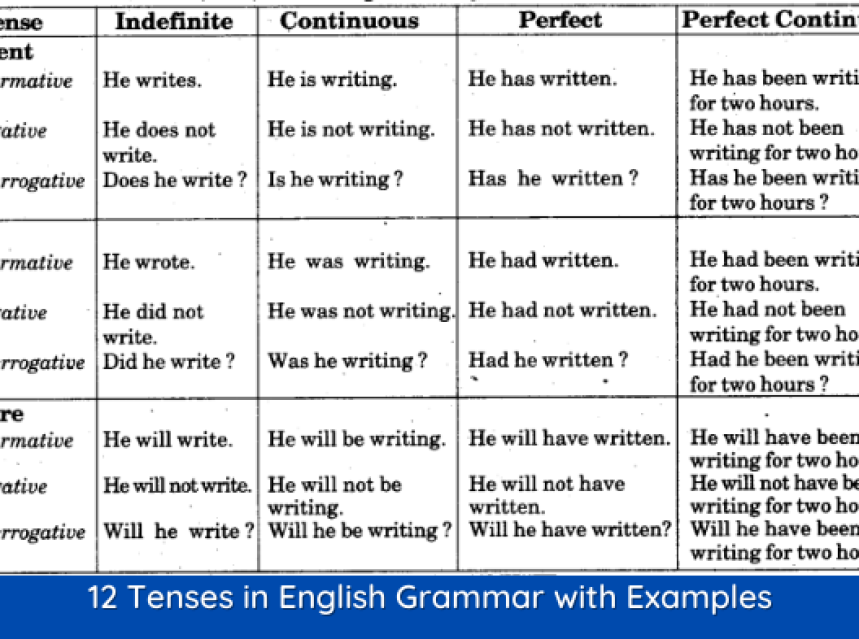
Learning the 12 English tenses can feel confusing at first. You may understand sentences like “I work,” “I am working,” and “I have worked” — but knowing why we choose one form instead of another is often the difficult part.
The good news is that you do not need to memorize everything at once.
In this guide, you will learn the 12 English tenses with simple formulas, common uses, time expressions, and real-life examples. You will also see some of the mistakes English learners commonly make and learn how similar tenses are different.
At the end, you can use our free 12 English tenses PDF charts for study, classroom practice, or quick revision.

What Are the 12 Tenses in English?
English learners usually study verb forms in three main time groups: present, past, and future. Each group is commonly taught in four forms: simple, continuous, perfect, and perfect continuous.
This gives us the familiar 12-tense system:
- Present Simple – I work.
- Present Continuous – I am working.
- Present Perfect – I have worked.
- Present Perfect Continuous – I have been working.
- Past Simple – I worked.
- Past Continuous – I was working.
- Past Perfect – I had worked.
- Past Perfect Continuous – I had been working.
- Future Simple – I will work.
- Future Continuous – I will be working.
- Future Perfect – I will have worked.
- Future Perfect Continuous – I will have been working.
Grammar note: The “12 tenses” system is a practical model commonly used for learning English. In more technical grammar descriptions, English tense and aspect may be analysed differently. For everyday English learning, however, the 12-form system is a useful way to organize and practise verb forms.
12 English Tenses PDF – Free Download

Want something you can save or print?
Download these free English tense charts for quick revision:
Study tip: Don’t just read the chart. Cover the examples and try to make your own sentence for each tense. This turns passive reading into active grammar practice.
Quick Guide to the 12 English Tenses
Before studying each tense in detail, look at how the meaning changes when we use the same verb:
Present Simple: I study English every day.
Present Continuous: I am studying English now.
Present Perfect: I have studied English for three years.
Present Perfect Continuous: I have been studying English since 2023.
Notice that the verb is related to the same activity — studying English — but the speaker’s view of the activity changes.
This is why learning meaning and context is more useful than memorizing formulas alone.
Present Tenses
1. Present Simple
Formula: Subject + base verb (V1)
For he, she, and it, we normally add -s or -es.
Examples:
I work from home.
She works at a hospital.
We use the Present Simple for:
- habits and routines: I drink coffee every morning.
- general facts: Water boils at 100°C at standard atmospheric pressure.
- regular situations: She lives in London.
- schedules and timetables: The train leaves at 8:30.
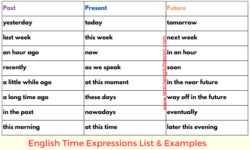
Common time expressions: always, usually, often, sometimes, never, every day, on Mondays
Negative: I do not (don’t) work on Sundays.
Question: Do you work on Sundays?
For he/she/it:
She doesn’t work on Sundays.
Does she work on Sundays?
Common mistake:
❌ She work every day.
✅ She works every day.
2. Present Continuous
Formula: Subject + am/is/are + verb-ing
Example: I am studying English right now.
We use the Present Continuous for:
- actions happening now: She is talking on the phone.
- temporary situations: I’m staying with my sister this week.
- changing situations: Your English is improving.
- future arrangements: We’re meeting Anna tomorrow.
Common time expressions: now, right now, at the moment, currently, today, this week
Negative: She isn’t studying now.
Question: Is she studying now?
Be careful with stative verbs. Verbs such as know, believe, understand, need, and want are not normally used in continuous forms when they describe states.
❌ I am knowing the answer.
✅ I know the answer.
3. Present Perfect
Formula: Subject + have/has + past participle (V3)
Example: I have finished my homework.
The Present Perfect connects the past with the present.
We use it for:
- past actions with a result now: I’ve lost my keys.
- life experiences: She has visited Italy three times.
- unfinished time periods: I’ve had two meetings today.
- situations continuing until now: We have lived here for five years.
Common words: already, yet, just, ever, never, recently, since, for
Negative: I haven’t finished yet.
Question: Have you finished yet?
Present Perfect or Past Simple?
Compare:
I visited Paris in 2024. → finished time in the past
I have visited Paris three times. → life experience; no finished past time is given
A common learner mistake is using the Present Perfect with a finished past-time expression:
❌ I have seen him yesterday.
✅ I saw him yesterday.
4. Present Perfect Continuous
Formula: Subject + have/has been + verb-ing
Example: I have been studying for two hours.
We often use this tense when an activity started in the past and has continued until now, or has recently stopped but has a visible present result.
Examples:
I’ve been waiting since 9 o’clock.
She has been working here for six months.
You’re wet! Have you been walking in the rain?
Common time expressions: for, since, all day, lately, recently
Since or for?
Since tells us when something started:
since Monday, since 2024, since 8 a.m.
For tells us the duration:
for two hours, for three weeks, for a long time
Past Tenses
5. Past Simple
Formula: Subject + past form (V2)
Example: I watched a movie yesterday.
We use the Past Simple for completed actions and situations in the past.
Examples:
We visited Rome last summer.
She called me yesterday.
I lived there for three years before moving to London.
Common time expressions: yesterday, last week, last year, ago, in 2020, when I was young
Regular verbs usually end in -ed:
work → worked
play → played
Irregular verbs have different forms:
go → went
see → saw
take → took
Negative: I didn’t go.
Question: Did you go?
Common mistake:
❌ I didn’t went.
✅ I didn’t go.
After did/didn’t, use the base form of the verb.
6. Past Continuous
Formula: Subject + was/were + verb-ing
Example: I was watching TV when she called.
The Past Continuous describes an activity that was in progress at a particular time in the past.
Examples:
At 8 p.m., I was doing my homework.
They were sleeping when the storm started.
While I was cooking, my brother was setting the table.
A very useful pattern is:
Past Continuous + when + Past Simple
I was walking home when it started to rain.
The longer activity was already happening; the shorter event happened during it.
7. Past Perfect
Formula: Subject + had + past participle (V3)
Example: The train had left before we arrived.
The Past Perfect helps us show which of two past events happened first.
Compare:
The train had left before we arrived.
1. The train left.
2. We arrived.
Another example:
When I got to the cinema, the film had already started.
Think of the Past Perfect as the “past before the past.”
8. Past Perfect Continuous
Formula: Subject + had been + verb-ing
Example: I had been studying for three hours before I took a break.
This tense emphasizes the duration of an activity before another past event or time.
Examples:
They had been waiting for an hour when the bus finally arrived.
She was tired because she had been working all day.
The second example is especially useful: the earlier activity explains a past result.
Future Forms
9. Future Simple with “Will”
Formula: Subject + will + base verb
Example: I will call you later.
We commonly use will for:
- decisions made at the moment of speaking: I’ll answer the phone.
- predictions: I think it will rain tomorrow.
- offers: I’ll help you with your bags.
- promises: I’ll call you tonight.
Negative: I will not (won’t) go.
Question: Will you go?
Will or Going To?
English has several ways to talk about the future.
Compare:
I’ll make some coffee. → decision made now
I’m going to make some coffee. → an intention or plan
We also often use the Present Continuous for arrangements:
I’m meeting Sarah at 6 p.m.
This is important because English learners should not assume that every future idea requires will.
10. Future Continuous
Formula: Subject + will be + verb-ing
Example: This time tomorrow, I will be flying to New York.
We use the Future Continuous for an activity that will be in progress at a particular future time.
Examples:
At 9 tomorrow morning, I’ll be working.
Don’t call at 8. We’ll be having dinner.
This time next week, they’ll be relaxing on the beach.
11. Future Perfect
Formula: Subject + will have + past participle (V3)
Example: I will have finished the project by Friday.
The Future Perfect looks forward to a future point and describes something that will be completed before that point.
Examples:
By next month, she will have completed the course.
They will have arrived by 6 p.m.
Useful time word: by
Here, by Friday means no later than Friday.
12. Future Perfect Continuous
Formula: Subject + will have been + verb-ing
Example: By noon, I will have been working for five hours.
This tense focuses on how long an activity will have continued by a particular future point.
Examples:
By December, she will have been teaching here for ten years.
Next month, we will have been living in this house for five years.
This tense is less common in everyday conversation than forms such as the Present Simple, Past Simple, and Present Perfect, so beginners do not need to master it first.
12 English Tenses at a Glance
| Tense | Basic Structure | Example |
|---|---|---|
| Present Simple | V1 / V1 + s | She works. |
| Present Continuous | am/is/are + -ing | She is working. |
| Present Perfect | have/has + V3 | She has worked. |
| Present Perfect Continuous | have/has been + -ing | She has been working. |
| Past Simple | V2 | She worked. |
| Past Continuous | was/were + -ing | She was working. |
| Past Perfect | had + V3 | She had worked. |
| Past Perfect Continuous | had been + -ing | She had been working. |
| Future with Will | will + V1 | She will work. |
| Future Continuous | will be + -ing | She will be working. |
| Future Perfect | will have + V3 | She will have worked. |
| Future Perfect Continuous | will have been + -ing | She will have been working. |
Which English Tenses Should Beginners Learn First?
If you are a beginner, you do not need to learn all 12 forms at the same time.
A practical learning order is:
Start with:
Present Simple → Present Continuous → Past Simple → basic future forms
Then learn:
Present Perfect → Past Continuous → Present Perfect Continuous
After you feel comfortable with these forms, move on to:
Past Perfect → Future Continuous → Future Perfect → Past Perfect Continuous → Future Perfect Continuous
The more advanced forms are useful, but they occur less frequently in everyday communication than core forms such as the Present Simple and Past Simple.
How to Choose the Correct Tense
Instead of asking only, “Which formula do I need?”, ask yourself these questions:
1. When does it happen?
Past, present, or future?
2. Is it a habit, fact, completed event, or activity in progress?
I work every day. vs. I’m working now.
3. Is there a connection between two times?
I’ve lost my keys. connects a past event with the present situation.
4. Is the duration important?
I’ve been studying for three hours.
5. Is there another event that gives you a reference point?
I had eaten before they arrived.
These questions help you understand the meaning behind the grammar.
Common English Tense Mistakes
Here are five mistakes worth checking in your own English:
1. Forgetting -s with he/she/it
❌ He work in London.
✅ He works in London.
2. Using the past form after did
❌ Did you went?
✅ Did you go?
3. Using Present Continuous with some stative verbs
❌ I am understanding.
✅ I understand.
4. Using Present Perfect with a finished past time
❌ I have visited her yesterday.
✅ I visited her yesterday.
5. Confusing since and for
❌ I’ve lived here since three years.
✅ I’ve lived here for three years.
✅ I’ve lived here since 2023.
A Simple Way to Practise English Tenses
Choose one everyday verb, such as study, and put it into different situations:
Routine: I study English every evening.
Right now: I am studying English now.
Past: I studied English yesterday.
Experience/progress: I have studied English for three years.
Past activity: I was studying when you called.
Future: I will study tonight.
Then replace study with verbs you actually use in your life: work, live, learn, travel, cook, watch, read, or play.
Grammar becomes easier when the examples are connected to your own life.
Quick Practice: Choose the Correct Tense
Complete the sentences with the correct form of the verb in brackets.
1. Sarah usually ________ to work at 8 a.m. (go) 1. goes
2. Be quiet! The baby ________. (sleep)
3. I ________ that movie three times. (see)
4. We ________ dinner when the lights went out. (eat)
5. He ________ the office before I arrived. (leave)
6. I think you ________ this book. (love)
7. By Friday, they ________ the project. (finish)
8. She ________ English for two hours, so she needs a break. (study)
Show answers
2. is sleeping
3. have seen
4. were eating
5. had left
6. will love
7. will have finished
8. has been studying
Final Tip: Learn Meaning, Not Just Formulas
A tense formula tells you how to build a sentence. It does not completely tell you when a native or proficient English speaker would choose that form.
So don’t try to memorize all 12 tenses in one sitting.
Start with the most useful forms, read and listen to English regularly, notice how verbs are used in context, and create examples about your own life.
Most importantly, compare similar forms:
I work. vs. I’m working.
I worked. vs. I’ve worked.
I worked. vs. I was working.
Understanding these differences will help you much more than memorizing twelve formulas.
Ready to review? Download the free English tense charts above and keep them nearby while you practise.



its very useful to us.thank you.
You are welcome!
Very usefull sir thanking you
Thanks for the PDF
Affirmative: Subject + Base Verb (V1) + Object
Negative: Subject + Do/Does + Not + Base Verb (V1) + Object
Interrogative: Do/Does + Subject + Base Verb (V1) + Object?
is tence may error ha
i never studding this method before my past period -good bless you and thanks a lot
Thank you for pointing this out! You’re right that the affirmative formula needs a little more detail. For most verbs in the Simple Present: **Affirmative:** Subject + Base Verb (V1) (+ s/es for he, she, it) + Object **Negative:** Subject + do/does + not + Base Verb (V1) + Object **Interrogative:** Do/Does + Subject + Base Verb (V1) + Object? For example: I work every day. She works every day. She does not work every day. Does she work every day? Note that the verb **“be”** follows a different pattern (I am, she is, they are). Thank you for helping… Read more »