
Common Suffixes in English and How to Use Them (PDF)
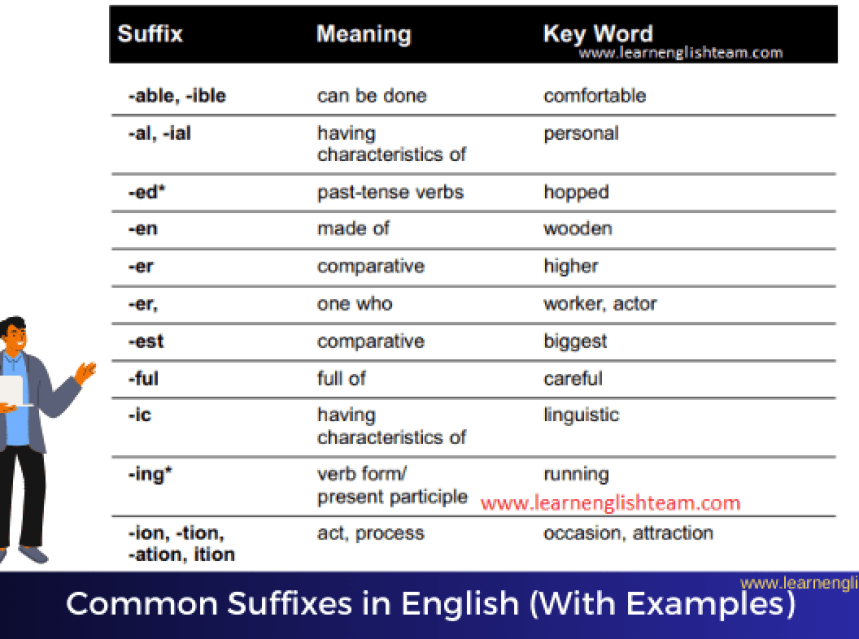
In this article, you’ll learn about common suffixes in English and how they change the meaning of words. Suffixes are groups of letters added to the end of a word, and they play a big role in helping you express ideas clearly and effectively. Think of suffixes as building blocks that help you expand your vocabulary and improve your English skills.
What Is a Suffix?
A suffix is a group of letters added to the end of a base word. It changes the word’s meaning or how it functions in a sentence. For example, by adding -er to the verb teach, we get teacher—someone who teaches. Just like that, suffixes turn ordinary words into new ones!
Why Are Suffixes Important?
Learning suffixes helps you:
- Understand the meaning of new words
- Form new words easily
- Speak and write with more precision
Mastering suffixes gives you more power to express your thoughts clearly and creatively.
How Do Suffixes Work?
Suffixes can change a word’s function or meaning. For instance:
- create + -ion = creation (a noun that means the act of creating)
- help + -ful = helpful (an adjective describing someone who helps)
Common English Suffixes and What They Mean
Here is a list of frequently used suffixes and what they do:
- -able: capable of being – drinkable, avoidable
- -al: having the nature of – central, political
- -ent: inclined to – different, excellent
- -ful: full of – beautiful, peaceful
- -ive: having the nature of – attractive, effective
- -less: without – careless, endless
- -ous: full of, characterized by – dangerous, famous
- -er: one who – teacher, writer
- -est: superlative form – strongest, fastest
- -ish: like, somewhat – childish, reddish
- -ism: belief, practice – realism, optimism
- -ize: to make or become – organize, specialize
- -tion: act or process – creation, communication
- -ness: state or condition – happiness, kindness
- -ly: in a certain way – quickly, happily
- -y: characterized by – sunny, rainy
- -ify: to make or cause – simplify, amplify
Examples and Functions of Common Suffixes
- -er: forms a noun meaning “a person who” – teacher, singer
- -ly: forms an adverb showing “how” – softly, happily
- -ful: forms an adjective meaning “full of” – joyful, helpful
- -tion: forms a noun from a verb – exploration, celebration
- -ed: forms the past tense of verbs – walked, danced
- -less: forms an adjective meaning “without” – fearless, endless
- -ment: forms a noun indicating a state – development, excitement
- -ing: forms the present participle – running, swimming
- -ly: also forms adjectives from nouns – manly, friendly
- -ize: forms verbs from nouns or adjectives – organize, specialize
Suffixes That Turn Verbs into Nouns
These suffixes are often used to form nouns from verbs:
- -tion / -sion: create → creation, discuss → discussion
- -ment: govern → government, move → movement
- -ance / -ence: attend → attendance, differ → difference
- -ing: teach → teaching, run → running
- -al: arrive → arrival
- -er / -or: create → creator, teach → teacher
- -ship: friend → friendship, leader → leadership
- -age: pack → package, manage → management
- -hood: brother → brotherhood, neighbor → neighborhood
- -ity / -ty: create → creativity, active → activity
Common Suffixes Chart




please send me the pdf file of thatcommon suffixes.
I like it and I learned a lot.
It is Very good work