
8 Parts of Speech in English: Guide + Free PDF Worksheets
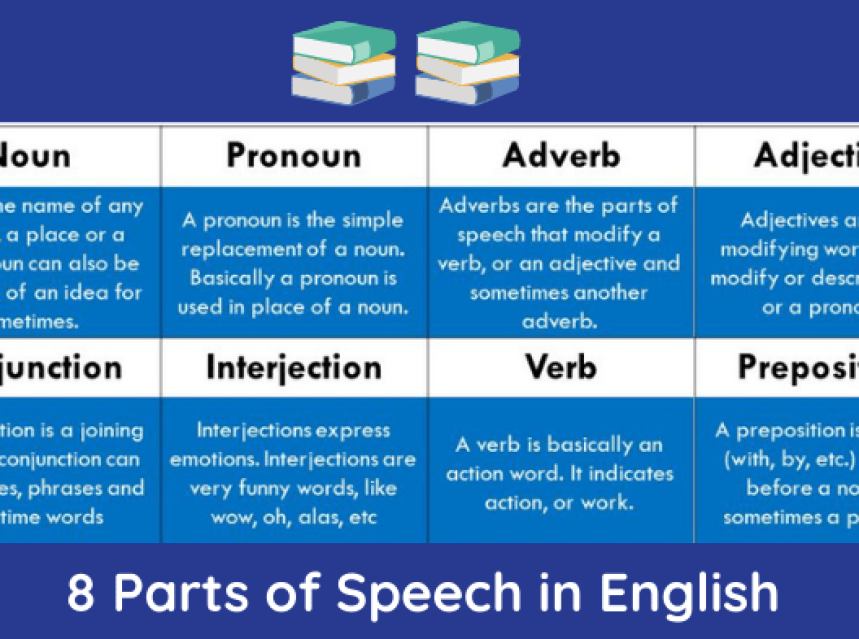
Understanding the eight parts of speech in English is one of the most important steps in learning grammar. Whether you are a beginner or an advanced learner, mastering these basics will help you speak, write, and understand English more clearly.
In this updated 2026 guide, you will find:
- Simple ESL-friendly explanations
- Clear examples for each part of speech
- Visual charts and tables
- Free downloadable PDF worksheets
What Are the 8 Parts of Speech?
Think of parts of speech as the jobs of words in a sentence. Just like people have roles (teacher, doctor, driver), words also have functions.
- Noun – names (dog, city, love)
- Pronoun – replaces nouns (I, you, they)
- Verb – actions (run, eat, be)
- Adjective – describes nouns (happy, tall)
- Adverb – describes verbs (quickly, very)
- Preposition – shows relationships (in, on, at)
- Conjunction – connects words (and, but)
- Interjection – expresses feelings (wow!, oh!)
Parts of Speech Chart

Parts of Speech Overview Chart
📥 Free Parts of Speech PDF Worksheets (Download)
We provide high-quality free PDFs for English learners and teachers.
Tip: Download and review daily for faster improvement.
The 8 Parts of Speech (Detailed Guide)
1. NOUN
A noun is the name of a person, place, thing, or idea.
Types of Nouns
Examples:
- Person: teacher, mother
- Place: city, park
- Thing: book, phone
- Idea: love, freedom
Quick Tips:
- Proper nouns start with a capital letter (London, Monday)
- Plural nouns often end in -s (books, cars)
- Abstract nouns cannot be seen (happiness, hope)
2. PRONOUN
A pronoun replaces a noun to avoid repetition.
Pronoun Types
Examples:
- I am learning English.
- Sarah is my friend. She is kind.
Common Types:
- Personal: I, you, they
- Possessive: mine, yours
- Reflexive: myself, yourself
- Interrogative: who, what
Quick Tips:
- Use pronouns to avoid repeating nouns
- Match pronoun with noun (he/she/it/they)
- Watch singular vs plural (it vs they)
3. VERB
A verb shows an action or a state.
Types of Verbs
Examples:
- She runs every morning.
- I am tired.
2026 Learning Tip:
Focus on verb forms (V1, V2, V3) and phrasal verbs.
Quick Tips:
- Every sentence needs a verb
- Learn irregular verbs early
- Pay attention to tense
4. ADJECTIVE
An adjective describes a noun.
Adjective Types
Examples:
- a beautiful place
- a big house
Quick Tips:
- Usually comes before the noun
- Makes sentences more interesting
- Don’t overuse adjectives
5. ADVERB
An adverb describes a verb, adjective, or another adverb.
Adverbs Types
Examples:
- She runs quickly.
- He is very smart.
Tip: Many adverbs end in -ly.
Quick Tips:
- Ask “how?” → adverb
- Not all -ly words are adverbs
- Avoid too many “very” words
6. PREPOSITION
A preposition shows the relationship between words.
Prepositions
Examples:
- The book is on the table.
- She is in the room.
Quick Tips:
- Always followed by a noun
- Small words, big mistakes
- Learn common combinations
7. CONJUNCTION
A conjunction connects words or sentences.
Conjunction Types
Examples:
- I like tea and coffee.
- She is tired but happy.
Quick Tips:
- “and” = add
- “but” = contrast
- “or” = choice
8. INTERJECTION
An interjection expresses strong emotion.
Examples:
- Wow! That’s amazing.
- Ouch! That hurts.
Quick Tips:
- Common in speaking
- Use exclamation marks (!)
- Keep them short
Conclusion
The 8 parts of speech are the foundation of English grammar. Practice daily with real examples and PDFs.
- Learn one part per day
- Practice with sentences
- Use worksheets
- Review PDFs regularly

Best examples for the students
Pratik dhamane
Useful lecture for whom studying English language from beginning. we hope you to upload more grammar lecture in pdf form
Sure! Don’t forget to subscribe our new lessons. 🙂
Very nice, thanks for the PDF.
Thanks for free PDF file.
I’m really enjoy Learning English.l find to the best to me
James