
200+ Irregular Verbs List with V1 V2 V3 Forms [Free PDF]
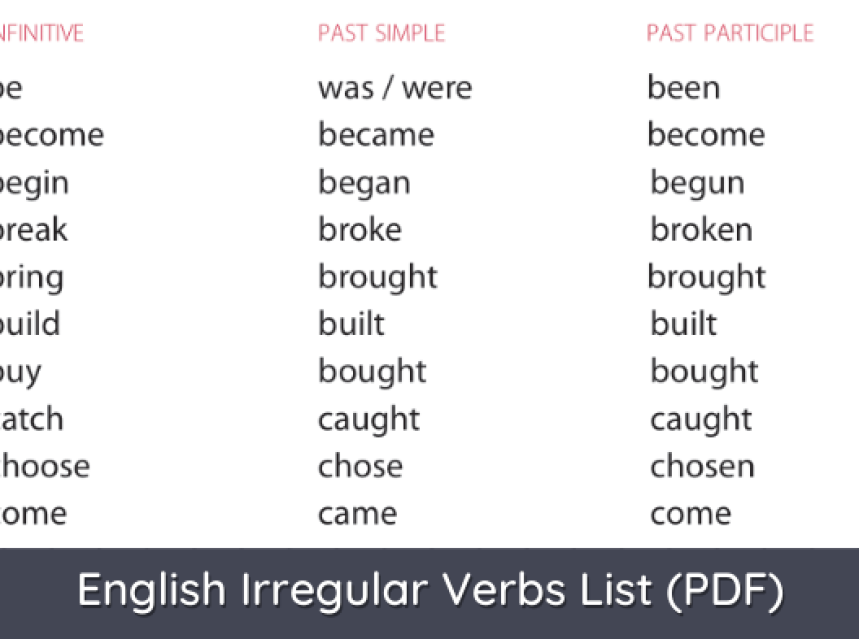
Are you looking for a complete irregular verbs list to improve your English? You’re in the right place. This guide covers 200+ irregular verbs with their base form (V1), past simple (V2), and past participle (V3) — plus tips to memorize them fast.
Irregular verbs are some of the most commonly used words in everyday English conversations. You’ll hear them in movies, songs, news, and daily talk. Mastering them is essential for fluency.
Pro tip: Don’t try to learn all 200 verbs in one day. Learn 10 verbs a day, spend at least 10 minutes practicing, and review them before bed. Repetition is the key to making them stick.
What Is the Difference Between Regular and Irregular Verbs?
Regular verbs follow a simple rule: add “-d” or “-ed” to the base form to make the past tense.
- look → looked
- talk → talked
- bake → baked
Irregular verbs do NOT follow this rule. Their past tense and past participle forms change in unpredictable ways:
- go → went → gone
- eat → ate → eaten
- buy → bought → bought
There is no single pattern for all irregular verbs, which is why you need to memorize them. But grouping them by pattern makes it much easier (see below).
Most Common Irregular Verbs List (V1 – V2 – V3)
Here are the 50 most common irregular verbs you need to know first:
| Base Form (V1) | Past Simple (V2) | Past Participle (V3) |
|---|---|---|
| be | was / were | been |
| have | had | had |
| do | did | done |
| go | went | gone |
| say | said | said |
| get | got | got / gotten |
| make | made | made |
| know | knew | known |
| think | thought | thought |
| take | took | taken |
| see | saw | seen |
| come | came | come |
| give | gave | given |
| find | found | found |
| tell | told | told |
| become | became | become |
| leave | left | left |
| feel | felt | felt |
| bring | brought | brought |
| begin | began | begun |
| keep | kept | kept |
| hold | held | held |
| write | wrote | written |
| stand | stood | stood |
| hear | heard | heard |
| let | let | let |
| mean | meant | meant |
| set | set | set |
| meet | met | met |
| run | ran | run |
| pay | paid | paid |
| sit | sat | sat |
| speak | spoke | spoken |
| read | read | read |
| grow | grew | grown |
| lose | lost | lost |
| fall | fell | fallen |
| send | sent | sent |
| build | built | built |
| understand | understood | understood |
| draw | drew | drawn |
| break | broke | broken |
| spend | spent | spent |
| cut | cut | cut |
| put | put | put |
| eat | ate | eaten |
| teach | taught | taught |
| buy | bought | bought |
| drive | drove | driven |
| drink | drank | drunk |
For the complete list of 200+ verbs, see the images and PDF below.
Learn Irregular Verbs by Pattern (The Smart Way)
Instead of memorizing verbs alphabetically, group them by how they change. This is faster and easier for your brain to process.
Pattern 1: No Change (V1 = V2 = V3)
These are the easiest. The verb stays the same in all three forms.
| V1 (Base) | V2 (Past Simple) | V3 (Past Participle) |
|---|---|---|
| cut | cut | cut |
| put | put | put |
| let | let | let |
| set | set | set |
| shut | shut | shut |
| hit | hit | hit |
| hurt | hurt | hurt |
| cost | cost | cost |
| quit | quit | quit |
| spread | spread | spread |
Pattern 2: Same Past Simple & Past Participle (V2 = V3)
| V1 (Base) | V2 (Past Simple) | V3 (Past Participle) |
|---|---|---|
| buy | bought | bought |
| bring | brought | brought |
| think | thought | thought |
| teach | taught | taught |
| catch | caught | caught |
| feel | felt | felt |
| keep | kept | kept |
| sleep | slept | slept |
| meet | met | met |
| send | sent | sent |
| build | built | built |
| lose | lost | lost |
| find | found | found |
| hold | held | held |
| tell | told | told |
| sell | sold | sold |
| say | said | said |
| pay | paid | paid |
| make | made | made |
| stand | stood | stood |
| understand | understood | understood |
| hear | heard | heard |
| have | had | had |
Pattern 3: Vowel Change i → a → u
The vowel changes from i to a to u. This is one of the most recognizable patterns.
| V1 (Base) | V2 (Past Simple) | V3 (Past Participle) |
|---|---|---|
| begin | began | begun |
| drink | drank | drunk |
| ring | rang | rung |
| sing | sang | sung |
| swim | swam | swum |
| sink | sank | sunk |
Pattern 4: Past Participle Ends in -en or -n
| V1 (Base) | V2 (Past Simple) | V3 (Past Participle) |
|---|---|---|
| break | broke | broken |
| choose | chose | chosen |
| speak | spoke | spoken |
| steal | stole | stolen |
| wake | woke | woken |
| drive | drove | driven |
| write | wrote | written |
| give | gave | given |
| take | took | taken |
| eat | ate | eaten |
| fall | fell | fallen |
| forget | forgot | forgotten |
| see | saw | seen |
| know | knew | known |
| grow | grew | grown |
| blow | blew | blown |
| fly | flew | flown |
| draw | drew | drawn |
| throw | threw | thrown |
| show | showed | shown |
Pattern 5: Completely Irregular (No Pattern)
These verbs don’t follow any pattern. You need to memorize them individually.
| V1 (Base) | V2 (Past Simple) | V3 (Past Participle) |
|---|---|---|
| be | was / were | been |
| go | went | gone |
| do | did | done |
Irregular Verbs Grouped by Formation (For Teachers)
If you’re teaching irregular verbs, organizing them by how the verb changes is more effective than alphabetical lists. Below are formation-based groups you can teach one at a time.
Group 1: No Change in Any Form
Start here to build student confidence. These verbs look the same in all tenses.
| V1 | V2 | V3 | Example Sentence |
|---|---|---|---|
| cut | cut | cut | I cut the paper yesterday. |
| put | put | put | She put the book on the table. |
| let | let | let | They let us go early. |
| hit | hit | hit | He hit the ball hard. |
| hurt | hurt | hurt | My leg hurt after the game. |
| shut | shut | shut | I shut the door quietly. |
| cost | cost | cost | The shoes cost $50. |
| quit | quit | quit | He quit his job last month. |
| spread | spread | spread | The news spread quickly. |
| set | set | set | She set the alarm at 6 AM. |
Group 2: Vowel Changes Only (Middle Sound Changes)
| V1 | V2 | V3 | Change Pattern |
|---|---|---|---|
| begin | began | begun | i → a → u |
| drink | drank | drunk | i → a → u |
| sing | sang | sung | i → a → u |
| swim | swam | swum | i → a → u |
| ring | rang | rung | i → a → u |
| sink | sank | sunk | i → a → u |
| sit | sat | sat | i → a → a |
| win | won | won | i → o → o |
| dig | dug | dug | i → u → u |
| stick | stuck | stuck | i → u → u |
| spin | spun | spun | i → u → u |
Group 3: Add -n or -en to Past Participle
| V1 | V2 | V3 | Change Pattern |
|---|---|---|---|
| break | broke | broken | V2 + n |
| choose | chose | chosen | V2 + n |
| speak | spoke | spoken | V2 + n |
| steal | stole | stolen | V2 + n |
| wake | woke | woken | V2 + n |
| freeze | froze | frozen | V2 + n |
| write | wrote | written | V2 + en (double consonant) |
| bite | bit | bitten | V2 + en (double consonant) |
| hide | hid | hidden | V2 + en (double consonant) |
| drive | drove | driven | V1 vowel + en |
| give | gave | given | V1 vowel + en |
| eat | ate | eaten | V1 + en |
| fall | fell | fallen | V1 + en |
| take | took | taken | V1 + n |
| shake | shook | shaken | V1 + n |
Group 4: Change to -ought or -aught
| V1 | V2 | V3 | Example Sentence |
|---|---|---|---|
| buy | bought | bought | I bought a new car. |
| bring | brought | brought | She brought cookies to the party. |
| think | thought | thought | I thought it was a good idea. |
| fight | fought | fought | They fought bravely. |
| seek | sought | sought | He sought help from a doctor. |
| teach | taught | taught | She taught English for 10 years. |
| catch | caught | caught | The dog caught the ball. |
Group 5: Change -d to -t
| V1 | V2 | V3 | Example Sentence |
|---|---|---|---|
| send | sent | sent | I sent the email this morning. |
| spend | spent | spent | We spent the weekend at home. |
| build | built | built | They built a new school. |
| lend | lent | lent | She lent me her umbrella. |
| bend | bent | bent | He bent the wire carefully. |
Group 6: Change -ee- to -e- (Shorten the Vowel)
| V1 | V2 | V3 | Example Sentence |
|---|---|---|---|
| feel | felt | felt | I felt happy after the news. |
| keep | kept | kept | She kept the secret. |
| sleep | slept | slept | He slept for 10 hours. |
| meet | met | met | We met at the café. |
| feed | fed | fed | She fed the cat. |
| bleed | bled | bled | His finger bled a little. |
| lead | led | led | She led the team to victory. |
Group 7: -ew in Past Simple, -own/-own in Past Participle
| V1 | V2 | V3 | Example Sentence |
|---|---|---|---|
| know | knew | known | I knew the answer. |
| grow | grew | grown | The plant has grown a lot. |
| blow | blew | blown | The wind blew hard last night. |
| throw | threw | thrown | He threw the ball to me. |
| fly | flew | flown | We have flown to London twice. |
| draw | drew | drawn | She drew a beautiful picture. |
Teaching Tip
Teach one group per lesson. After each group, ask students to make their own sentences using the verbs. Review the previous group before introducing a new one. This spiral method helps long-term retention.
How to Memorize Irregular Verbs (5 Effective Tips)
- Learn 10 verbs a day. Don’t overwhelm yourself. Focus on a small group each day and review before sleep.
- Group by pattern. As shown above, learn similar verbs together. Your brain remembers patterns better than random lists.
- Use them in sentences. Write your own examples: “I woke up at 7. I ate breakfast. I went to work.”
- Practice with flashcards. Write V1 on one side, V2 and V3 on the other. Test yourself daily.
- Watch English content. Pay attention to irregular verbs in movies, YouTube videos, and songs. Hearing them in context helps you remember naturally.
Example Sentences with Irregular Verbs
Understanding how irregular verbs work in the past tense is easier with real examples:
- I went to the supermarket yesterday. (go → went)
- She bought a new phone last week. (buy → bought)
- We have eaten lunch already. (eat → eaten)
- He forgot his keys at home. (forget → forgot)
- They spoke to the manager about the problem. (speak → spoke)
- I have written three emails today. (write → written)
- The kids ran to the park after school. (run → ran)
- She has driven this car for five years. (drive → driven)
Irregular Verbs List – Images


Frequently Asked Questions (FAQ)
How many irregular verbs are there in English?
There are approximately 200-250 irregular verbs in English, but only about 50-100 are commonly used in everyday conversation.
What is the fastest way to learn irregular verbs?
Group them by pattern (as shown above), learn 10 per day, write example sentences, and review regularly. Flashcards and listening to English content also help.
Why do irregular verbs exist in English?
Irregular verbs come from Old English and Germanic language roots. They are some of the oldest and most frequently used words in the language, which is why they kept their original forms instead of becoming regular.
What is the difference between V1, V2, and V3?
V1 is the base form (go), V2 is the past simple (went), and V3 is the past participle (gone). V3 is used with perfect tenses (have gone) and passive voice (was gone).
Irregular Verbs Full List PDF (Free Download)
Download the complete irregular verbs list as a printable PDF:
Irregular Verbs Full List PDF – Free Download
Video: Learn Irregular Verbs
Related Posts:
Irregular Verbs and How to Learn Them Easily (Free PDF)
Irregular Plural Nouns in English – Rules, Exercises & List (PDF)
500+ English Verbs List (V1 V2 V3 Verb Forms)
Quick and Easy Way to Learn English Verb Tenses (Free PDF)


Good but can it be group base on formation for someone teaching
Thanks!