
300+ IELTS Vocabulary Words List – Free PDF (2026)
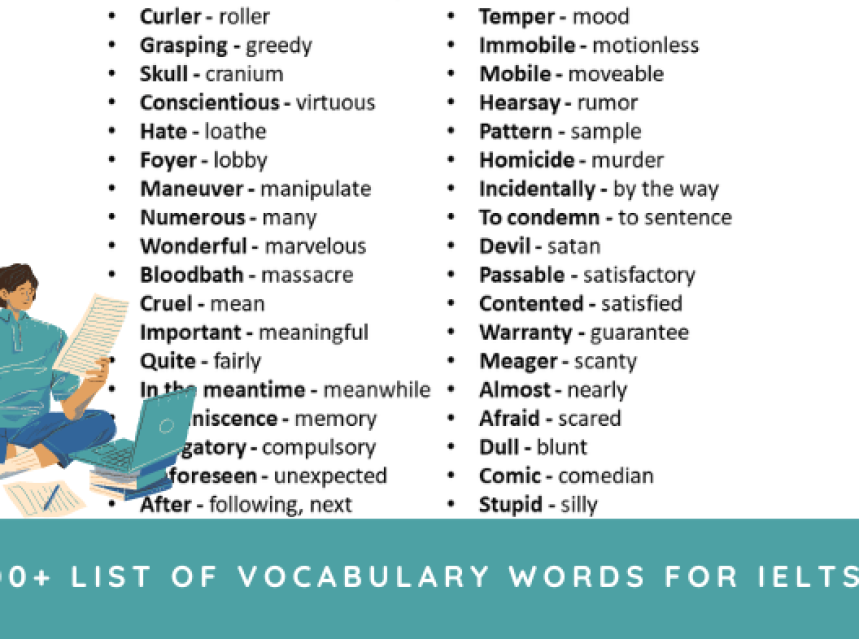
Learning IELTS vocabulary is one of the best ways to improve your band score. Whether you are preparing for the Speaking, Listening, Reading or Writing section, a strong vocabulary helps you understand complex texts and express your ideas clearly.
In this post, you will find 300+ IELTS vocabulary words organized by topic, each with a synonym and an example sentence. These words are commonly found in academic texts and IELTS exam materials. If you are aiming for Band 6, 7 or 8, this is the vocabulary boost you need.
Tip: Download the free PDF at the bottom of this page and use it for daily practice.

Why Synonyms Matter in IELTS
In the IELTS exam, using different words with the same meaning shows your language proficiency. The examiners call this lexical resource — it is one of the key criteria in Writing and Speaking. If you repeat the same words, your score goes down. If you use synonyms naturally, your score goes up. It is that simple.
For example, instead of writing “important” three times in one essay, you can use essential, crucial, or fundamental. This small change can make a big difference in your band score.
1. Describing People & Personality
These words help you describe people in the IELTS Speaking and Writing sections. Use them when talking about characters, friends, family or public figures.
| Word | Synonym | Example Sentence |
|---|---|---|
| Arrogant | haughty | He was too arrogant to listen to anyone’s advice. |
| Brave | courageous | The firefighter was brave enough to enter the burning building. |
| Clever | intelligent | She is a very clever student who solves problems quickly. |
| Aggressive | militant | His aggressive behavior made everyone uncomfortable. |
| Eccentric | unusual | The artist had an eccentric personality that people admired. |
| Sincere | honest | He gave a sincere apology for his mistake. |
| Immodest | conceited | It is immodest to talk about your achievements all the time. |
| Vicious | ferocious | The dog was vicious and attacked the stranger. |
| Wise | knowing | My grandmother is a wise woman who always gives good advice. |
| Mischievous | impish | The mischievous child hid his sister’s toys. |
| Ambitious | aspiring | She is an ambitious woman who wants to become a CEO. |
| Mean | unkind | Don’t be mean to your classmates. |
| Naughty | disobedient | The naughty student refused to follow the teacher’s instructions. |
| Negligent | inattentive | The negligent driver caused the accident. |
| Hostile | antagonistic | The crowd became hostile when the game was cancelled. |
| Infantile | childish | His infantile jokes annoyed everyone at the meeting. |
| Handsome | good-looking | He is a handsome man with bright blue eyes. |
| Beautiful | attractive | The city has many beautiful old buildings. |
| Trustworthy | reliable | A good friend should be trustworthy. |
| Beneficent | generous | The beneficent donor helped build a new school. |
| Animated | lively | She is an animated speaker who keeps the audience interested. |
| Impetuous | reckless | Making impetuous decisions can lead to problems. |
| Stupid | dense | It was a stupid mistake that could have been avoided. |
2. Emotions & Feelings
Use these words to describe how people feel. They are useful in IELTS Speaking Part 2 when describing experiences, and in Writing Task 2 when discussing social issues.
| Word | Synonym | Example Sentence |
|---|---|---|
| Crazy | insane | The fans went crazy when the team scored the winning goal. |
| Terror | fright | She screamed in terror when she saw the spider. |
| Ecstasy | joy | He was filled with ecstasy after hearing the good news. |
| Jealous | envious | She felt jealous when her friend got promoted. |
| Misery | distress | Losing his job brought him great misery. |
| Joy | delight | The children jumped with joy on Christmas morning. |
| Hate | loathe | I hate waking up early in the winter. |
| Miserable | depressing | The rainy weather made everyone feel miserable. |
| Doubt | mistrust | There is no doubt that education is important. |
| Ardor | passion | She spoke with great ardor about protecting the environment. |
| Comfort | consolation | His kind words were a great comfort to her. |
| Remorse | regret | He felt deep remorse for hurting his friend’s feelings. |
| Morose | sullen | He became morose after losing the competition. |
| Livid | furious | My father was livid when he saw the broken window. |
| Mourn | grieve | The whole nation mourned the loss of the great leader. |
| Infuriate | enrage | His rude comments infuriated everyone in the room. |
| Mirth | fun | The party was full of mirth and laughter. |
| Cranky | cross | Babies get cranky when they are tired. |
| Humiliate | embarrass | The teacher should never humiliate a student in front of the class. |
3. Actions & Verbs
These action words appear frequently in IELTS Reading passages and Writing tasks. Knowing their synonyms helps you paraphrase questions and answers more effectively.
| Word | Synonym | Example Sentence |
|---|---|---|
| To accomplish | to achieve | She worked hard to accomplish her goals. |
| To desert | to abandon | He decided to desert his old plan and try something new. |
| To disclose | to reveal | The company refused to disclose its financial records. |
| To establish | to set up | They plan to establish a new branch in London. |
| To vary | to differ | Prices vary depending on the season. |
| To disclaim | to deny | The politician tried to disclaim responsibility for the failure. |
| To behave | to act | Children should learn to behave properly in public. |
| To administer | to manage | The hospital needs more staff to administer patient care. |
| To maintain | to preserve | It is important to maintain a healthy diet. |
| To foretell | to predict | No one can foretell what will happen in the future. |
| To ignore | to disregard | You should not ignore the warning signs. |
| To consult | to refer to | Please consult your doctor before taking this medicine. |
| To hurry | to rush | We need to hurry or we will miss the train. |
| To elevate | to raise, to promote | Education can elevate people out of poverty. |
| To disappear | to vanish | Many animal species disappear every year due to habitat loss. |
| To grab | to seize | She grabbed her bag and ran to the bus stop. |
| To annoy | to irritate, to bother | Loud music can annoy your neighbors. |
| To notify | to inform | The school will notify parents about the schedule change. |
| To emphasize | to stress | The report emphasizes the need for better healthcare. |
| To encounter | to come across | You may encounter some difficulties during the test. |
| To evaluate | to assess | The teacher will evaluate your essay based on four criteria. |
| To explode | to blow up | The population exploded in the 20th century. |
| To collapse | to break down | The old bridge finally collapsed after years of neglect. |
| To accumulate | to build up | Debt can accumulate quickly if you are not careful. |
| To select | to choose | Please select the correct answer from the options below. |
| To illuminate | to clarify, to light up | The professor tried to illuminate the complex topic with simple examples. |
| To differentiate | to distinguish | It is difficult to differentiate between the two species. |
| To nominate | to appoint | The committee will nominate a new chairman next week. |
| To withstand | to resist | This material can withstand extreme temperatures. |
| To convey | to communicate | Art can convey powerful messages without words. |
| To respond | to reply | The government was slow to respond to the crisis. |
| To conform | to comply | All students must conform to the school’s dress code. |
| To admit | to confess | He had to admit that he was wrong. |
| To intensify | to heighten | The storm is expected to intensify over the weekend. |
| To transform | to convert | Technology has transformed the way we communicate. |
| To diminish | to decrease | The supply of fresh water continues to diminish. |
| To collect | to gather | Researchers collected data from over 1,000 participants. |
| To deduce | to infer | From the evidence, we can deduce that the suspect was lying. |
| To renounce | to give up | He decided to renounce his old habits and start fresh. |
| To assure | to guarantee | I can assure you that the project will be completed on time. |
| To survive | to outlive | Only the strongest businesses survive during a recession. |
| To visualize | to imagine | Try to visualize the answer before you write it down. |
| To vanquish | to conquer | The army vanquished the enemy after a long battle. |
| To magnify | to exaggerate | The media tends to magnify small problems. |
| To impeach | to question | The lawyer tried to impeach the witness’s credibility. |
| To cite | to quote | You should always cite your sources in academic writing. |
| To quake | to tremble | The ground began to quake during the earthquake. |
| To inspect | to examine | The engineers will inspect the building for safety. |
4. Describing Things & Situations
These adjectives and adverbs help you describe objects, places and situations. They are especially useful in IELTS Writing Task 1 (describing charts and graphs) and Speaking Part 2 (describing a place or event).
| Word | Synonym | Example Sentence |
|---|---|---|
| Awful | terrible | The weather was awful during our vacation. |
| Accurate | correct | The data in the report is accurate and up to date. |
| Cozy | comfortable | The small café has a cozy atmosphere. |
| Vague | indistinct | His answer was too vague to be useful. |
| Abundant | ample | The region has an abundant supply of natural resources. |
| Defective | faulty | The defective product was returned to the factory. |
| Dormant | inactive | The volcano has been dormant for over 200 years. |
| Turbulent | blustering | The country went through a turbulent period of political change. |
| Drab | dull | The office was drab and needed a fresh coat of paint. |
| Superb | magnificent | The hotel had a superb view of the ocean. |
| Enormous | huge, immense | The project required an enormous amount of funding. |
| Obsolete | out of date | Many traditional skills have become obsolete due to technology. |
| Monotonous | boring | The work was monotonous and repetitive. |
| Identical | duplicate | The twins look almost identical. |
| Essential | fundamental | Clean water is essential for human survival. |
| Vacant | empty | There were several vacant seats in the theater. |
| Huge | vast | The Sahara Desert covers a huge area of North Africa. |
| Lethal | deadly | Air pollution can be lethal in highly industrialized cities. |
| Infrequent | rare | Snow is infrequent in tropical countries. |
| Spontaneous | automatic | The audience broke into spontaneous applause. |
| Dark | dismal | The basement was dark and cold. |
| Unlawful | illegal | Dumping waste in the river is unlawful. |
| Dangerous | unsafe | Texting while driving is dangerous. |
| Inflexible | rigid | The company’s inflexible rules frustrated employees. |
| Undeniable | indisputable | The evidence against him was undeniable. |
| Dubious | doubtful | The claim sounded dubious and needed more proof. |
| Reliable | dependable | Public transport should be fast and reliable. |
| Intriguing | fascinating | The documentary presented an intriguing theory about climate change. |
| Inferior | substandard | The quality of the product was inferior to the original. |
| Consecutive | successive | It rained for five consecutive days. |
| Dry | arid | The dry climate makes farming very difficult. |
| Prompt | immediate | We received a prompt reply from the manager. |
| Vast | huge | The internet provides access to a vast amount of information. |
| Stationary | fixed | The car hit a stationary vehicle at the traffic light. |
| Aromatic | fragrant | The kitchen was filled with the aromatic smell of fresh bread. |
| Revolting | disgusting | The smell from the factory was absolutely revolting. |
| Torpid | lethargic | The heat made everyone feel torpid and unproductive. |
5. Academic & Formal Words
These words appear frequently in IELTS Reading passages and are useful for Writing Task 2. Knowing academic synonyms helps you paraphrase and avoid repetition in your essays.
| Word | Synonym | Example Sentence |
|---|---|---|
| Perception | insight | Public perception of the issue changed after the report was published. |
| Understandable | comprehensible | The instructions should be understandable to all readers. |
| Indisputable | undeniable | The link between smoking and cancer is indisputable. |
| Neutral | impartial | A good journalist should remain neutral when reporting the news. |
| Interplay | interaction | There is a complex interplay between genetics and environment. |
| Oblique | indirect | She made an oblique reference to the scandal in her speech. |
| Virtue | advantage | One virtue of online learning is its flexibility. |
| Appreciable | considerable | There has been an appreciable improvement in air quality. |
| Impediment | obstacle | Lack of funding is the main impediment to progress. |
| Abstract | summary | The abstract of the research paper explained the key findings. |
| Substantially | considerably | The cost of living has increased substantially in recent years. |
| Especially | particularly | Vocabulary is important, especially for the Writing section. |
| Completely | totally | The project was completely redesigned after the review. |
| Exactly | precisely | The experiment must be repeated exactly as described. |
| Deliberately | intentionally | The information was deliberately hidden from the public. |
| Moderately | reasonably | The restaurant is moderately priced and popular with students. |
| Priority | precedence | Education should be a top priority for every government. |
| Previous | preceding | Compared to the previous year, sales increased by 15%. |
| Citation | quotation | Every academic essay should include proper citations. |
| Applicable | relevant | This rule is applicable to all employees. |
| Imperative | crucial | It is imperative that we act now to protect the environment. |
| Moral | ethical | There are moral questions about using animals for testing. |
| Constancy | fidelity | The constancy of the results proved the experiment was reliable. |
| Abbreviate | condense | Please abbreviate your answer to 150 words or fewer. |
| Momentous | powerful | The election was a momentous event in the country’s history. |
| Spotlight | highlight | The report spotlights the challenges facing rural schools. |
| Disaster | catastrophe | The oil spill was an environmental disaster. |
| Conflict | clash | There is often a conflict between economic growth and environmental protection. |
| Turmoil | disturbance | The country was in turmoil after the economic crisis. |
| Repute | reputation | Harvard is a university of great repute. |
| Zenith | peak | The empire reached its zenith in the 16th century. |
| Remark | comment | The professor made an interesting remark about the study. |
| Insurgent | rebel | The insurgent forces challenged the government. |
| Uprising | rebellion | The uprising was caused by years of social inequality. |
6. Everyday Vocabulary
These are common words that you may hear or read in daily English. Knowing their synonyms can help you understand IELTS Listening and Reading passages better.
| Word | Synonym | Example Sentence |
|---|---|---|
| Blameless | innocent | The investigation proved that she was blameless. |
| Immediate | instant | We need an immediate solution to this problem. |
| Warranty | guarantee | The phone comes with a two-year warranty. |
| Fortunate | lucky | We were fortunate to find a hotel at the last minute. |
| Isolated | lonely | The village is isolated and far from any major city. |
| Dicey | risky | Investing in that company seems a bit dicey. |
| Bendy | flexible | The new phone has a bendy screen. |
| Extra | additional | We need extra time to complete the assignment. |
| Lousy | awful | The service at that restaurant was lousy. |
| Infamous | notorious | The city is infamous for its heavy traffic. |
| Idle | lazy | He spent the afternoon idle, doing nothing productive. |
| Hearsay | rumor | The story was based on hearsay, not facts. |
| Gratuity | tip | In many countries, a 10% gratuity is expected at restaurants. |
| Disadvantaged | deprived | The program aims to help disadvantaged children. |
| Eager | keen | The students were eager to start the new project. |
| Mediocre | fair | His performance in the test was mediocre at best. |
| Rubbish | nonsense | That excuse is total rubbish. |
| Disagreeable | unpleasant | The smell from the factory was very disagreeable. |
| Unfortunate | unlucky | It was unfortunate that the event was cancelled due to rain. |
| Curative | healing | Some people believe in the curative power of herbal medicine. |
| Fragrance | perfume | The fragrance of fresh flowers filled the room. |
| Nightfall | dusk | The markets close at nightfall. |
| Sundown | sunset | We watched the sundown from the beach. |
| Overseas | abroad | Many students go overseas to study at top universities. |
| Informal | casual | The dress code for the party is informal. |
| Necessary | essential | A passport is necessary for international travel. |
| Difficult | hard | The IELTS Reading section can be difficult for many students. |
| Steady | regular | There has been a steady increase in online shopping. |
| Discount | reduction | Students can get a 20% discount with a valid ID. |
| Praise | compliment | The teacher gave her praise for her excellent essay. |
| Immune | exempt | No country is immune to the effects of climate change. |
| Ban | forbid | Many countries have decided to ban single-use plastics. |
| Insufferable | unbearable | The heat was insufferable during the summer months. |
| Peaceable | peaceful | They found a peaceable solution to the dispute. |
| Dilute | weaken, thin | You should dilute the juice with water before drinking. |
| Convalesce | recover | He went to the countryside to convalesce after his surgery. |
Free IELTS Vocabulary PDFs
Download these free PDF files to study IELTS vocabulary offline. Print them out and use them as daily study guides.
- IELTS Academic Wordlist PDF – Download
- 500 Words You Need to Know for IELTS PDF – Download
- 100 Important IELTS Synonyms Quiz (MCQ) – Download
Related Resources:
- Vocabulary Books for IELTS Exam & PDF
- Vocabulary for Describing Graphs and Charts (IELTS)
- List of Synonym Words for IELTS + PDF
- IELTS Synonyms Online Quiz
- IELTS Speaking Topics
How to Learn IELTS Vocabulary Effectively
Memorizing long word lists does not work for most students. Here are five proven methods that will help you remember new vocabulary and use it in the IELTS exam.
1. Group words by topic. Instead of learning random words, organize them by themes like education, health, technology or environment. This makes it easier to remember them during the exam because IELTS topics follow these themes.
2. Learn words in sentences, not in isolation. When you learn a new word, always write a sentence with it. For example, do not just memorize “abundant = ample.” Instead, write: “The country has abundant natural resources.” This helps your brain connect the word to a real situation.
3. Use spaced repetition. Review new words after 1 day, then 3 days, then 7 days. Apps like Englishpix use spaced repetition automatically, so you study at the right time.
4. Practice using synonyms in your writing. When you write IELTS practice essays, challenge yourself to replace common words with synonyms. Write your essay first with simple words, then go back and upgrade them.
5. Read IELTS sample answers. Pay attention to how synonyms are used in model answers. This shows you how high-band students use vocabulary naturally — not just listing fancy words, but using them in the right context.
Frequently Asked Questions
How many vocabulary words do I need for IELTS Band 7?
For Band 7, you should know around 4,000 to 5,000 English words. However, it is not just about the number. You need to know how to use these words correctly in sentences. Focus on learning words with their collocations (word combinations), not just definitions.
What is the best way to learn IELTS vocabulary fast?
The fastest method is to combine reading with active practice. Read IELTS passages, highlight new words, learn their synonyms, and then use them in your own sentences. Using flashcard apps with spaced repetition will also help you remember words much faster than simply reading a list.
Should I learn all the words on this list?
No, you do not need to learn every word. Start with the words you do not know and focus on those first. If you already know a word and its synonym, skip it. Quality is more important than quantity — it is better to know 100 words deeply than 500 words superficially.
Can vocabulary alone improve my IELTS score?
Vocabulary is one of four scoring criteria (along with grammar, coherence and pronunciation/task response). A strong vocabulary will improve your score, but you also need to practice grammar, essay structure and speaking fluency. Think of vocabulary as one important piece of the puzzle, not the whole picture.
Where can I practice these IELTS vocabulary words?
You can practice with our free online IELTS Synonyms Quiz or download the PDF files above for offline study. For interactive vocabulary practice with games and spaced repetition, try Englishpix.


love the words but correction=terrror = frighti need 399 topic related ielts speaking c1 vocabulary
its really helpfully
100 Important IELTS Synonyms Quiz MCQ – download can tell the answer is wrong from Q1, can you provide the correct one?