
V1 V2 V3 V4 V5 — 100 Verb Forms List, Chart & Free PDF Download
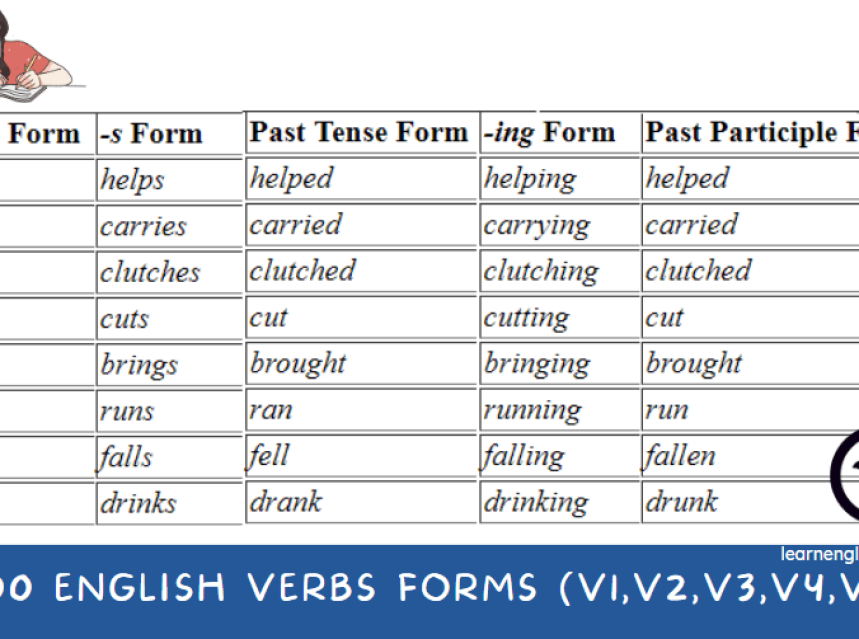
English verbs are the foundation of every sentence. If you want to speak, write, and understand English confidently, you must learn how verbs change in different tenses.
Many learners feel confused when they see forms like go – went – gone – going – goes. Don’t worry — this guide will make everything simple.
In this lesson, you will learn 100 common English verbs with all five forms (V1, V2, V3, V4, V5), understand when to use each form, and practice with a free worksheet.
What Are V1, V2, V3, V4, V5?
English verbs are often taught with five main forms. These forms are used in different tenses and sentence structures. Here is what each one means:
- V1 (Base Form): The simple form of the verb — go, eat, see
- V2 (Past Simple): Used for finished actions in the past — went, ate, saw
- V3 (Past Participle): Used with have/has/had and in passive voice — gone, eaten, seen
- V4 (-ing Form): Used in continuous tenses — going, eating, seeing
- V5 (Third Person Singular): Used with he, she, it in present simple — goes, eats, sees
Important note: Some verbs are very irregular. The verb be is the most important example because it changes to am, is, are, was, were, been, and being.
How to Use Each Verb Form With Examples
V1 — Base Form
Use V1, or the base form, after to, after modal verbs such as can, will, should, must, and with most subjects in the present simple.
- I go to school every day.
- They eat breakfast at 8 AM.
- She wants to see the movie.
- We can help you.
Be careful: The verb be is special. In standard English, we do not usually say I be, you be, or they be in the present simple. We say:
- I am
- You / We / They are
- He / She / It is
Examples:
- I am happy.
- You are ready.
- She is a teacher.
V2 — Past Simple
Use V2 to talk about finished actions in the past. No helping verb is needed.
- I went to the park yesterday.
- She ate lunch an hour ago.
- We saw a great movie last night.
V3 — Past Participle
Use V3 with have / has / had in perfect tenses and in passive voice.
- I have gone to that restaurant before.
- She has eaten already.
- The letter was written by Tom.
V4 — Present Participle (-ing Form)
Use V4 with am / is / are / was / were for continuous tenses.
- I am going to the store now.
- She is eating dinner.
- They were playing football.
V5 — Third Person Singular
Use V5 with he, she, it in the present simple. Usually, we add -s or -es.
- He goes to work at 9 AM.
- She eats fruit every morning.
- It seems easy.
100 Common English Verbs — V1 V2 V3 V4 V5 List
This table includes 100 common English verbs with their main forms. Use it as a reference when you study, write, or speak English.
Note: In American English, the V3 form of get is often gotten. In British English, people often use got.
| V1 | V2 | V3 | V4 | V5 |
|---|---|---|---|---|
| be | was/were | been | being | is |
| have | had | had | having | has |
| do | did | done | doing | does |
| say | said | said | saying | says |
| go | went | gone | going | goes |
| get | got | gotten/got | getting | gets |
| make | made | made | making | makes |
| know | knew | known | knowing | knows |
| think | thought | thought | thinking | thinks |
| take | took | taken | taking | takes |
| see | saw | seen | seeing | sees |
| come | came | come | coming | comes |
| want | wanted | wanted | wanting | wants |
| use | used | used | using | uses |
| find | found | found | finding | finds |
| give | gave | given | giving | gives |
| tell | told | told | telling | tells |
| work | worked | worked | working | works |
| call | called | called | calling | calls |
| try | tried | tried | trying | tries |
| ask | asked | asked | asking | asks |
| need | needed | needed | needing | needs |
| feel | felt | felt | feeling | feels |
| become | became | become | becoming | becomes |
| leave | left | left | leaving | leaves |
| put | put | put | putting | puts |
| mean | meant | meant | meaning | means |
| keep | kept | kept | keeping | keeps |
| let | let | let | letting | lets |
| begin | began | begun | beginning | begins |
| seem | seemed | seemed | seeming | seems |
| help | helped | helped | helping | helps |
| talk | talked | talked | talking | talks |
| turn | turned | turned | turning | turns |
| start | started | started | starting | starts |
| show | showed | shown | showing | shows |
| hear | heard | heard | hearing | hears |
| play | played | played | playing | plays |
| run | ran | run | running | runs |
| move | moved | moved | moving | moves |
| live | lived | lived | living | lives |
| believe | believed | believed | believing | believes |
| bring | brought | brought | bringing | brings |
| write | wrote | written | writing | writes |
| sit | sat | sat | sitting | sits |
| stand | stood | stood | standing | stands |
| lose | lost | lost | losing | loses |
| pay | paid | paid | paying | pays |
| meet | met | met | meeting | meets |
| include | included | included | including | includes |
| continue | continued | continued | continuing | continues |
| set | set | set | setting | sets |
| learn | learned | learned | learning | learns |
| change | changed | changed | changing | changes |
| lead | led | led | leading | leads |
| understand | understood | understood | understanding | understands |
| watch | watched | watched | watching | watches |
| follow | followed | followed | following | follows |
| stop | stopped | stopped | stopping | stops |
| create | created | created | creating | creates |
| speak | spoke | spoken | speaking | speaks |
| read | read | read | reading | reads |
| spend | spent | spent | spending | spends |
| grow | grew | grown | growing | grows |
| open | opened | opened | opening | opens |
| walk | walked | walked | walking | walks |
| win | won | won | winning | wins |
| teach | taught | taught | teaching | teaches |
| offer | offered | offered | offering | offers |
| remember | remembered | remembered | remembering | remembers |
| love | loved | loved | loving | loves |
| consider | considered | considered | considering | considers |
| appear | appeared | appeared | appearing | appears |
| buy | bought | bought | buying | buys |
| wait | waited | waited | waiting | waits |
| serve | served | served | serving | serves |
| die | died | died | dying | dies |
| send | sent | sent | sending | sends |
| build | built | built | building | builds |
| stay | stayed | stayed | staying | stays |
| fall | fell | fallen | falling | falls |
| cut | cut | cut | cutting | cuts |
| reach | reached | reached | reaching | reaches |
| kill | killed | killed | killing | kills |
| raise | raised | raised | raising | raises |
| pass | passed | passed | passing | passes |
| sell | sold | sold | selling | sells |
| decide | decided | decided | deciding | decides |
| return | returned | returned | returning | returns |
| explain | explained | explained | explaining | explains |
| hope | hoped | hoped | hoping | hopes |
| develop | developed | developed | developing | develops |
| carry | carried | carried | carrying | carries |
| break | broke | broken | breaking | breaks |
| receive | received | received | receiving | receives |
| agree | agreed | agreed | agreeing | agrees |
| support | supported | supported | supporting | supports |
| hit | hit | hit | hitting | hits |
| produce | produced | produced | producing | produces |
| eat | ate | eaten | eating | eats |
| cover | covered | covered | covering | covers |
| catch | caught | caught | catching | catches |
| draw | drew | drawn | drawing | draws |
| choose | chose | chosen | choosing | chooses |
Regular and Irregular Verb Rules
- Regular verbs are easy. Add -ed for V2 and V3: work → worked → worked
- Irregular verbs change in different ways. You need to memorize them: go → went → gone
- For V4, usually add -ing: go → going, eat → eating
- For V5, usually add -s or -es: work → works, watch → watches
- If V1 ends in -y after a consonant, change y to i and add -es: try → tries, carry → carries
- The verb be is special: I am, you are, he is, she is, it is, we are, they are
Special Note About “Be”
The verb be is one of the most irregular verbs in English. It does not follow the normal V1 and V5 pattern in the present simple.
| Subject | Correct Form | Example |
|---|---|---|
| I | am | I am ready. |
| You | are | You are kind. |
| He / She / It | is | She is happy. |
| We / They | are | They are students. |
In standard English, we do not normally say I be happy or they be students. These forms may appear in some dialects, songs, or informal expressions, but learners should use am, is, and are in standard grammar.
Advanced note: In some conditional sentences, English uses were even with singular subjects:
- If I were smarter, I would solve this problem faster.
- If she were here, she would help us.
This is a special grammar structure called the subjunctive. Beginners do not need to worry about it too much, but it is useful to know that be has special forms.
Printable Worksheet Practice
Exercise 1: Fill in the Blanks
- She ___ (go) to school every day.
- They have ___ (eat) lunch.
- He is ___ (play) football now.
- We ___ (see) that movie yesterday.
- I have ___ (finish) my homework.
- She ___ (teach) English every Monday.
- We have ___ (buy) a new car.
- He is ___ (run) in the park.
- They ___ (build) a house last year.
- I have ___ (write) three emails today.
Exercise 2: Choose the Correct Answer
- She (go / goes) to work every day.
- They have (eat / eaten) dinner.
- He is (run / running) fast.
- We (was / were) happy.
- I have (see / seen) this before.
- She (speak / speaks) three languages.
- The window was (break / broken) by the ball.
- He has (chose / chosen) the blue one.
- They are (wait / waiting) for the bus.
- She (carry / carries) her bag every day.
Exercise 3: Complete the Sentences With the Correct Form of “Be”
- I ___ happy today.
- She ___ my teacher.
- They ___ at home.
- We ___ ready for the lesson.
- He ___ very tired.
Click to see answers
Exercise 1: 1. goes 2. eaten 3. playing 4. saw 5. finished 6. teaches 7. bought 8. running 9. built 10. written
Exercise 2: 1. goes 2. eaten 3. running 4. were 5. seen 6. speaks 7. broken 8. chosen 9. waiting 10. carries
Exercise 3: 1. am 2. is 3. are 4. are 5. is
Frequently Asked Questions
What is the difference between V2 and V3?
V2, or past simple, is used alone to describe a finished action:
I went to school.
V3, or past participle, is used with a helping verb like have, has, had or in passive sentences:
I have gone to school.
The cake was eaten.
How many irregular verbs are there in English?
There are about 200 irregular verbs in English, but learners usually need around 50–70 for daily conversation. The table above covers many of the most important ones.
What is the easiest way to memorize verb forms?
The best way is to practice daily. Read the verb list, write example sentences, and use the worksheet. You can also group similar verbs together. For example, bring–brought–brought and buy–bought–bought follow the same pattern.
Do all verbs have five forms?
Most English verbs are taught using five main forms: V1, V2, V3, V4, and V5. Regular verbs are simple because V2 and V3 are usually the same. Irregular verbs may change completely.
However, some verbs are more irregular. The verb be is the best example because it has several special forms: am, is, are, was, were, been, being.
Why is the verb “be” special?
The verb be is special because it does not follow the normal present simple pattern. We say I am, you are, and he is. We do not normally say I be or he be in standard English.
What is the V3 form of “get”?
In American English, the V3 form of get is often gotten. In British English, people often use got. Both forms can be correct depending on the variety of English.
Free PDF Download
Tip: Print the worksheet and practice every day to improve faster.



Very informative! Good job done. Its definitely helping thousands of people. Keep it up!!
good job
Good and informative…. Except for one misleading bit ^^; [Use V1 with I, you, we, they in present simple, after to, and after modal verbs (can, will, should, must).] This applies to *most* verbs, but not those that have a different base form and present tense, such as “be”. While “I be” or “you/we/they be” might be used colloquially or as part of an idiom, standard English uses am and are, respectively. (I have no idea whether there actually are other verbs like that; at least I can’t think of one right now.) On a side note, “be” is also… Read more »
Thanks for pointing that out — you are absolutely right about the verb “be.” I’ve updated the article to clarify that the rule applies to most verbs, while “be” is a special irregular verb with forms like am, is, and are. I also added a note about conditional forms such as “If I were…”. Really appreciate the helpful feedback!