
You Don’t Need B2: How a Low-Score English Proficiency Certificate Opens Specific Doors
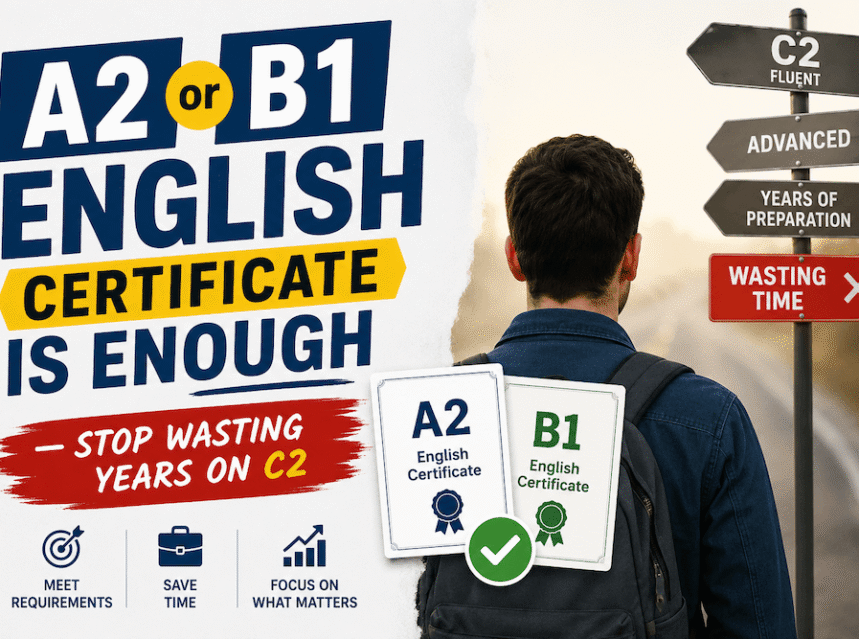
The message from the test-prep industry is drilled into us early: “Aim for C2. Nothing less will do.” We are told a high score is the only key to the global marketplace. However, this one-size-fits-all approach isn’t just stressful; it can be a costly and inefficient detour for many. The truth is, for a huge number of roles and immigration pathways, a B1 or even an A2 English certificate is more than enough.
This article will show you why aiming for a “perfect score” can sometimes be the wrong goal and how targeting a lower, more achievable threshold can open specific doors faster and cheaper.

The CEFR Scale: A Quick Reference
Before we dive into specifics, here’s a quick guide to the language levels we’ll be discussing:
- A2 (Elementary): You can understand sentences and frequently used expressions related to areas of immediate relevance (e.g., basic personal and family information, shopping, local geography, employment).
- B1 (Intermediate): You can deal with most situations likely to arise while traveling in an area where the language is spoken. You can produce simple connected text on topics that are familiar or of personal interest.
Doors That Open with A2 and B1
Here are the specific professions and visa routes where an A2 or B1 certificate is your ticket in.
Professions Perfect for A2
If your career goal is to enter the workforce quickly in hands-on or support roles, A2 is your target.
- Production and Packaging Workers: A job posting in the Netherlands for an Entry Level Production and Packaging Worker explicitly lists the requirement as: English Level: A2. No previous experience is necessary, and on-the-job training is provided.
- Warehouse Workers: General warehouse and inventory sorting roles often require only A2 English to follow basic safety and sorting instructions.
- Cleaning and Housekeeping Staff: Positions in housekeeping and room attending, especially in hospitality, are accessible with an A2 certificate.
- Basic Hospitality Roles: Entry-level jobs in food preparation, dishwashing, and kitchen assistance are also great fits for A2-level English speakers.
Professions and Visas Perfect for B1
With a B1 certificate, you unlock a wider range of positions and immigration options.
- Call Center Agent (English Account): A job listing for a call center agent requires an English level of B1+.
- Manufacturing Operator: Many manufacturing and lab technician positions list “Basic English Skills” as the requirement, which corresponds to the B1 level.
- Specific UK Work Visa Routes (Pre-2026 Changes): Historically, the UK Skilled Worker visa required a B1 level. While requirements are increasing for new applications, this historical data illustrates the viability of B1 for professional immigration.
- Visa Extensions and Family Visas: The UK requires an A2 level for extending a family visa after 2.5 years and for certain permission to stay applications.
- Student Visa (Below Degree Level): For students planning to study in the UK at a level below a bachelor’s degree (e.g., foundation courses), a B1 certificate is the required level.
- Electrical and Electronics Specialist: Some technical roles, such as an Electronics & Circuit Logic Specialist, specifically ask for Basic (B1) English to understand project instructions and labels.
The Benefit: Saving Your Time and Money
The pressure to achieve a C1 or C2 level comes with significant costs:
- Time: Achieving a high level of fluency can take years of dedicated study.
- Money: High-level test preparation courses and expensive exam fees can cost thousands of dollars.
For the roles listed above, the level of English required is simply that of everyday communication and basic workplace instruction. Focusing on achieving a solid A2 or B1 certification is often all you need, allowing you to enter the workforce and start earning sooner. Why spend two years studying for a C2 exam when the job you want only requires an A2?
How to Get Your Certificate
If you’ve realized that a high-level certification is overkill for your goals, the next step is getting the certificate you do need. Services like Testizer offer a fast, efficient, and recognized solution. You can take a free English proficiency test online to determine your current level and, upon successful completion, order a digital certificate. This certificate includes a unique number and a QR code for employers to verify its authenticity, making it a practical tool for your job search or visa application.
Conclusion
The one-size-fits-all message of “high score or bust” is a myth. The global job market is diverse, and so are its language needs. By identifying the specific requirements of your target role or visa, you can set a realistic, achievable goal and bypass the unnecessary stress of chasing a perfect score. Sometimes, the most strategic move is to aim for “good enough”—and with an A2 or B1 certificate, “good enough” can be the key to a new career.
FAQs
1. Which official exams offer A2 or B1 certifications, and how do they compare to the Testizer test?
Common options include IELTS (scores 3–4 for A2, 4–5 for B1), TOEIC Listening & Reading (A2: 120–225, B1: 225–550), and Cambridge English exams (KEY for A2, PET for B1). Unlike these, Testizer provides a purely online, shorter-format assessment with a digital certificate — ideal for quick verification without a test center visit.
2. How long is an A2 or B1 certificate valid, and do I need to renew it?
Most traditional certificates (IELTS, TOEIC, Cambridge) are valid for 2 years for immigration purposes. However, many employers in manual labor or hospitality roles accept certificates up to 5 years old. Digital certificates from services like Testizer typically don’t expire but may require re-verification if issued more than 3 years ago.
3. Can I use an A2 certificate to apply for a job in a non-English speaking country where English is the workplace language?
Yes. In countries like Germany, the Netherlands, and Sweden, many logistics and manufacturing companies explicitly state “English proficiency A2 required” in job postings. The certificate proves you can follow safety instructions and basic team communication — even if the local language is different.
4. What happens if I score higher than B1 on a test I took for a low-threshold role?
Nothing negative. You can still submit the higher score — it won’t disqualify you. However, you might have wasted time and money over-preparing. For roles that only check a “minimum A2” box, a B2 or C1 certificate is overkill and offers no extra advantage in hiring or visa processing.
5. Do all countries accept the same CEFR thresholds for work visas, or do they differ significantly?
They differ. For example, Germany’s “skilled worker” visa for logistics or hospitality often requires only A2. Japan’s specified skilled worker visa (e.g., food service) requires A2–B1. Poland and Czech Republic accept A2 for many manual labor permits. The UK and Australia are stricter (usually B1 minimum for most work visas). Always check the specific visa category.
6. How can I prove my A2 level without taking a new test if I already have old school records?
Some employers accept a high school diploma that shows English as a subject, but this is risky. Many visa authorities require a dated, verifiable certificate. Your best bet is a low-cost online verification test (like Testizer) that takes 30 minutes and provides a fresh, employer-friendly digital badge with a QR code.
7. Is there a risk that targeting a low certificate will make me look less ambitious to employers?
No — not for the roles listed. A warehouse manager or seasonal hospitality recruiter cares only about minimum communication competence. Including an A2 certificate shows honesty and self-awareness. Claiming a higher level you don’t have (and failing a practical check) will hurt you far more than presenting a modest but accurate certificate.
8. Can I combine an A2 English certificate with another skill (e.g., forklift license, food safety training) to get hired faster?
Absolutely. This is a powerful strategy. Many employers in logistics and production list “A2 English + valid forklift certificate” or “B1 English + HACCP food safety” as a preferred combination. The language certificate unlocks the door; the vocational skill gets you the job.
9. Are digital-only certificates from online tests accepted by embassies and visa officers?
Increasingly, yes — but with caveats. For lower-threshold work visas (e.g., temporary agricultural worker permits in EU countries), a digital certificate with a verification link is accepted. For permanent residency or highly regulated visas, embassies still prefer IELTS or Cambridge. Always check the specific visa checklist first.
10. What’s the fastest way to upgrade from A2 to B1 if I later need it for a better role?
Focus on job-specific vocabulary rather than general fluency. For example, learning 200 common warehouse or kitchen phrases can push you from A2 to B1 in 4–6 weeks of part-time study. Avoid expensive general English courses. Use free apps (Duolingo, Memrise) and practice listening to workplace dialogues on YouTube. Then retake a low-cost online test monthly until you hit B1.

I am interested in learning English
ok i want to get the certificate
If you would like to get a free English certificate, we recommend using QuizYourEnglish.com. You can take online English tests and receive a certificate for free!