Separable and Inseparable Phrasal Verbs in English (PDF)
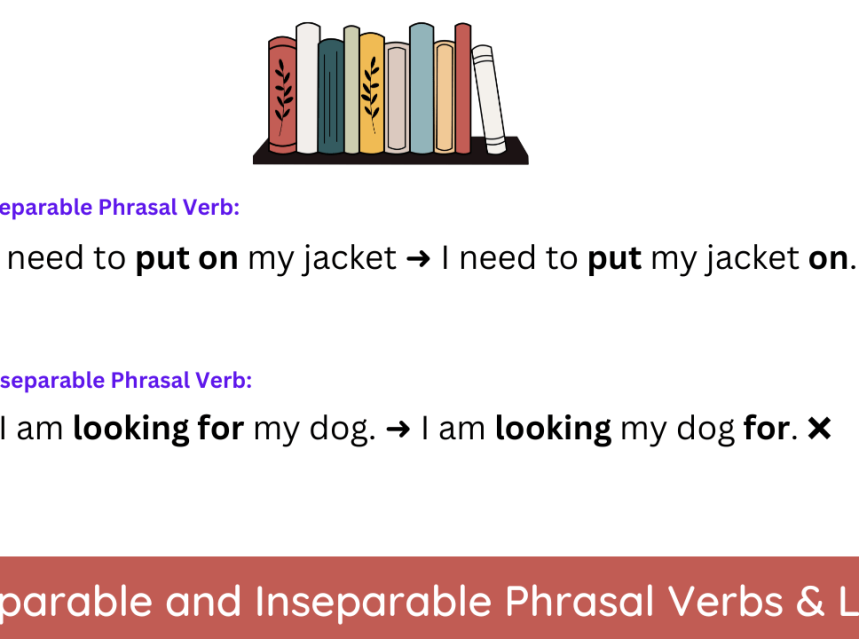
Phrasal verbs are one of the most important — and challenging — parts of English. If you want to sound natural, fluent, and confident, you must understand how they work.
In this post, you will learn the difference between separable and inseparable phrasal verbs with clear rules, examples, and usage tips. A phrasal verb is a verb like run away, give up, hold on, stand up. It is made of a main verb + a preposition or adverb, and together they create a new meaning.
When we add a preposition or adverb to a verb, the meaning often changes completely.
For example, when we add up to the verb give, the meaning is no longer “offer” — it becomes “quit” or “stop trying.”
| Word | Meaning | |
|---|---|---|
| give | ➜ | main verb |
| up | ➜ | preposition / adverb |
| give up | ➜ | phrasal verb meaning: stop doing something, quit |
Let’s see give up in real sentences:
- I won’t give up easily.
- I gave up smoking two years ago.
- She gave up sugar.
- They gave up the game.
- Don’t give up on your goals.
Phrasal verbs are divided into two main groups:
- Separable Phrasal Verbs
- Inseparable Phrasal Verbs

Separable Phrasal Verbs
If a phrasal verb is separable, you can put the object:
- between the verb and the particle, or
- after the whole phrasal verb
Example:
- She will call off the meeting.
- She will call the meeting off.
When the object is a pronoun (him, her, it, them), it must go in the middle:
- She will call it off. ✅
- She will call off it. ❌
More examples:
- She picked up her sister.
- She picked her sister up.
- She picked her up.
Check also:
2000+ Common Phrasal Verbs List From A-Z (Free PDF)
Phrasal Verbs List and How to Learn Them Easily (Free PDF)
Useful Phrasal Verbs List: Basic Actions
Inseparable Phrasal Verbs
Inseparable phrasal verbs cannot be split. The object always comes after the phrasal verb.
- We set off for the concert. ✅
- We set for the concert off. ❌
- She is looking after her father. ✅
- She is looking her father after. ❌
| Phrasal Verb | Type | Example |
|---|---|---|
| Turn off | Separable | She turned the light off. |
| Turn on | Separable | He turned the TV on. |
| Take off | Separable | The plane took off at dawn. |
| Put off | Separable | They put the meeting off. |
| Break down | Inseparable | The car broke down on the highway. |
| Break up | Inseparable | They broke up after five years. |
| Get up | Inseparable | She got up early this morning. |
| Get off | Inseparable | He got off the bus. |
Understanding whether a phrasal verb is separable or inseparable will help you speak and write English more naturally and confidently.
You can download the full list with examples below:
Separable and Inseparable Phrasal Verbs List (PDF Download)
Practice: Separable or Inseparable?
Try to decide if the phrasal verb is separable or inseparable. Then check the answers below.
- She turned off the lights before leaving.
- We set off early in the morning.
- He picked up the phone quickly.
- They looked after the children all weekend.
- I gave up junk food last month.
Answers:
- 1 → Separable
- 2 → Inseparable
- 3 → Separable
- 4 → Inseparable
- 5 → Inseparable (cannot be separated: ❌ gave food up junk)
FAQ – Separable & Inseparable Phrasal Verbs
Why are phrasal verbs important in English?
Phrasal verbs are used every day by native speakers. If you understand them, your English will sound more natural, fluent, and confident.
How can I tell if a phrasal verb is separable?
If you can put the object between the verb and the particle (like turn the light off), it’s separable. If you cannot, it’s inseparable.
Where does the pronoun go in separable phrasal verbs?
With pronouns (him, her, it, them), the object must go in the middle: turn it off, not turn off it.
Can all phrasal verbs be separated?
No. Many common phrasal verbs are inseparable, such as look after, get on, run into, and set off.
What is the best way to learn phrasal verbs?
Learn them in context, not as single words. Read stories, listen to audio, and practice using phrasal verbs in real sentences.