Why A Custom T-Shirt Manufacturer Starts With Fabric
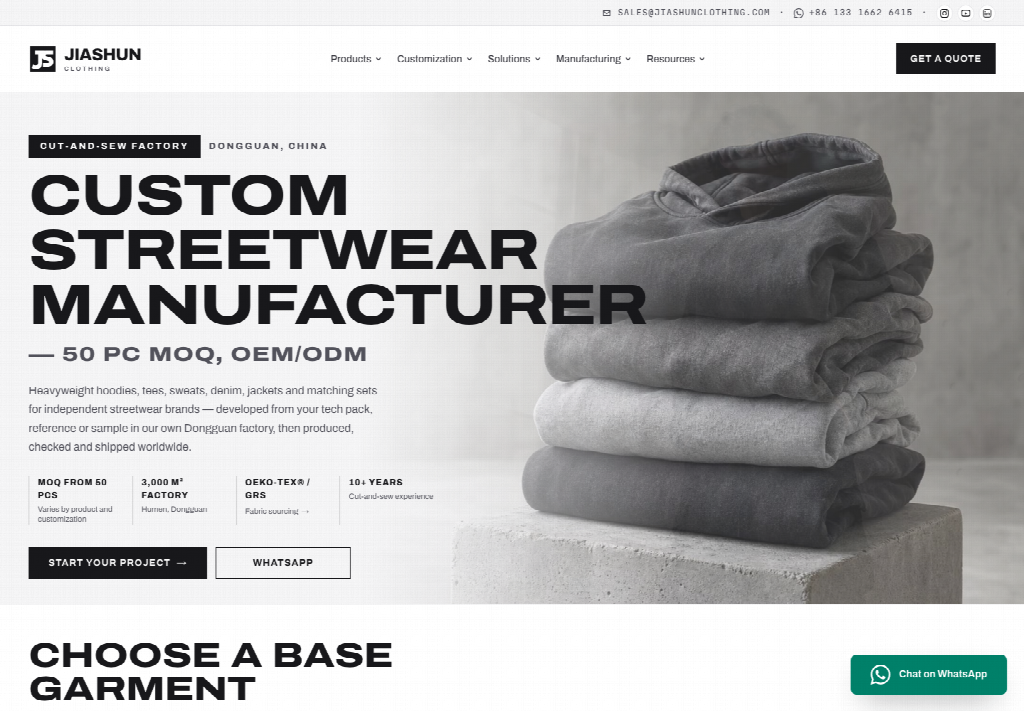
A clothing idea can begin with a print, a colour story or a photograph, but the wearer meets the fabric before the artwork. A custom streetwear manufacturer is most useful when the material brief is specific enough to protect fit, handfeel and repeatability, rather than treating fabric as a blank surface waiting for a logo.
That matters especially for small labels that sell softness, responsible sourcing or a recognisable everyday feel. “Heavy,” “organic,” “vintage” and “comfortable” are useful directions, not finished specifications. The weight, knit density, fibre content, shrinkage behaviour and decoration method all change what the customer receives. A beautiful graphic cannot repair a fabric decision that was never made.
The Swatch Carries More Risk Than The Logo
A logo is easy to move in a design file. A fabric choice moves through every later decision: pattern measurements, drape, collar recovery, print adhesion, embroidery support, wash response, packing weight and the way the product is described. If the material is chosen only because its colour looks right in a swatch photo, the first physical version has to answer too many questions at once.
There is also a customer-facing cost. A tee that feels thin when the product page implies structure, or a hoodie that becomes stiff around a large decoration, creates a mismatch that is hard to explain away. The first version may look acceptable on a table and become obviously wrong when worn. That is the point at which the team discovers that the artwork was approved before the product had a body.

For a small range, the practical fix is to make the material brief carry the same status as the artwork brief. The brief should state what the fabric must feel like, what it must survive and which decoration or wash decisions it must support. Those constraints make a quote more comparable and a sample more useful.
Turn A Material Preference Into A Buying Brief
Jiashun Clothing describes fabric sourcing through type, weight, stretch, handfeel, colour direction and wash. It also asks buyers to consider shrinkage risk and decoration compatibility before sampling. That is a better starting point than sending a reference photo with one adjective attached. The goal is not to sound technical. The goal is to give the factory a decision that can be checked.
Record Weight Handfeel And Shrinkage Risk
Write down the desired weight or range, but do not pretend GSM tells the whole story. Knit density and fibre content affect how a number feels on the body. Add a sentence about drape, softness, firmness or warmth, then name the risk that matters most: shrinkage, collar recovery, pilling, colour variation or a surface that changes after washing.
When a custom t shirt manufacturer reviews a reference garment, a swatch or a tech-pack note, those details let the team suggest a feasible direction instead of guessing from appearance. The conversation can stay practical: which material is close enough, what needs a counter-swatch, and what must be proven on the sample before a bulk quantity is considered.
Match Each Decoration To The Surface
Decoration is a material decision too. Screen print sits on the surface and can make sense for bold graphics with a limited colour count. DTG suits photo-real artwork or many colours on cotton. Puff print needs simple shapes that can read as a raised form, while heat transfer can hold small names, numbers and gradients with a slightly more plasticised finish.
Embroidery adds another question: can the fabric support the stitch density without making a chest panel stiff? Jiashun Clothing recommends checking thread colour, backing, placement and the surface result during sample approval. If the artwork becomes unreadable, too rigid or visually heavy against the fabric, the problem is not solved by enlarging the logo. It needs a different decoration choice or a different base.
Use The Numbers To Narrow The Build
Material ranges are useful when they narrow a decision, not when they become a catalogue. Jiashun Clothing lists the following working bands for common streetwear builds:
| Material family | Typical range | Useful question |
| Cotton jersey | 180–300 gsm | Will the collar and body keep the intended shape? |
| Fleece or French terry | 300–500 gsm | Does the handfeel match the warmth and drape? |
| Denim | 10–14 oz | How will composition and wash change the result? |
| Nylon or poly shell | Lightweight | Has print adhesion been proven on the surface? |
The value of the table is the question in the last column. A number without a purpose is just another way to postpone the decision. A small team can choose one reference band, explain why it fits the product, and ask the sample to prove the rest.
Jersey And Fleece Carry Different Promises
A tee and a hoodie may share artwork but not the same material logic. Cotton jersey in a lighter band can support an everyday top, while fleece or French terry changes warmth, bulk and the way a print sits. The same artwork may need a different scale or decoration method once the base becomes thicker. If the design depends on a crisp edge, test the edge on the chosen surface rather than borrowing confidence from a flat mockup.
Ask For Evidence Before Calling It Sustainable
Sustainability language becomes more useful when it is attached to a material requirement. Jiashun Clothing says buyers can request OEKO-TEX Standard 100 Class I fabric options or GRS-certified recycled fabrics where the programme requires them. That does not turn every garment into a universal claim. It gives the buyer a question to place in the brief: which certification, for which fabric, and how will the option be identified in the quote and sample discussion?
The same discipline applies to “organic,” “recycled” or “responsibly made” language on a product page. Keep the claim close to the evidence the project can actually support. If the factory needs the requirement stated alongside fabric type and weight, write it there instead of adding a broad promise after the product has already been designed.
Where A Material Brief Still Needs Proof
A fabric brief cannot remove every variable. Special weights, colours, washes or trims can affect MOQ, sample timing and bulk lead time. The sample still has to settle drape, shrinkage, handfeel and decoration response, and certified options still need to be confirmed for the actual programme. Treat the brief as a filter for good questions, not as proof that the finished garment is already approved.
Vocabulary Table: Key Terms From This Article
These ten words appear throughout the article. Each one includes a short definition and an example sentence to show how it is used in context.
| Word | Meaning | Example Sentence |
| Handfeel | The way a fabric feels when touched | The handfeel of this cotton jersey is soft and smooth. |
| Repeatability | The ability to produce the same result again | Repeatability matters when a brand orders a second batch. |
| Shrinkage | The amount a fabric gets smaller after washing | Always check shrinkage risk before approving a sample. |
| Drape | The way fabric hangs or falls on the body | Fleece has a heavier drape than light cotton jersey. |
| Adhesion | How well a print or decoration sticks to the surface | Print adhesion must be tested on nylon shells. |
| Stitch density | The number of stitches in a given area | High stitch density can make a chest panel stiff. |
| Counter-swatch | An alternative fabric sample offered for comparison | The factory sent a counter-swatch with a softer finish. |
| MOQ | Minimum order quantity | Special colours often raise the MOQ for small labels. |
| Certified | Officially approved against a standard | They requested GRS-certified recycled fabrics. |
| Tech-pack | A document with technical details for production | The tech-pack listed weight, colour, and decoration notes. |