
8 Parts of Speech Definitions and Examples with Simple Sentences
What Are the Parts of Speech? (Quick Answer)
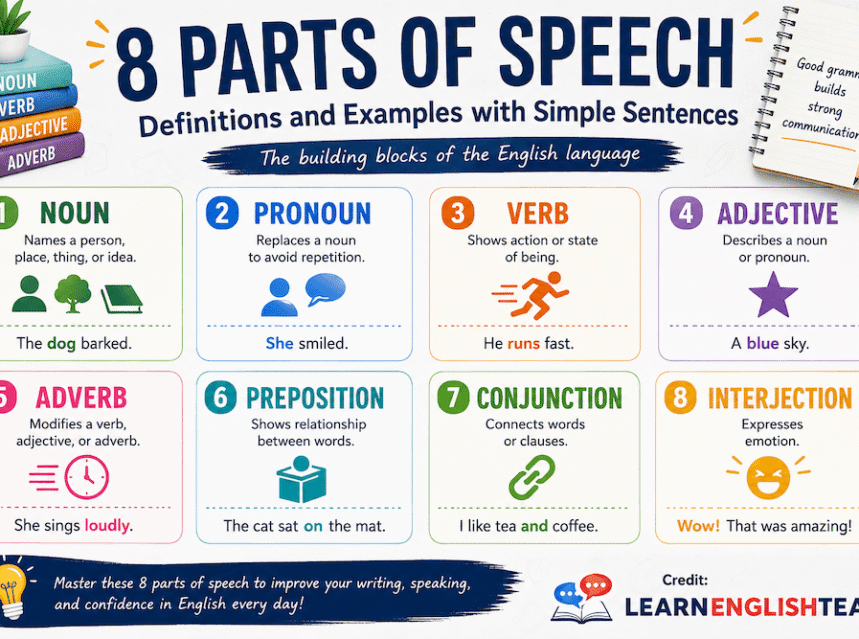
The 8 parts of speech are the building blocks of the English language: nouns, pronouns, verbs, adjectives, adverbs, prepositions, conjunctions, and interjections. Every word you speak or write belongs to one of these categories. Understanding parts of speech definitions and examples helps you write more clearly, speak more confidently, and score better on standardized tests like the SAT, ACT, or GRE.
According to the National Council of Teachers of English (NCTE), grammar fluency including mastery of parts of speech is a foundational skill for academic writing and communication in 2024 and beyond. Whether you’re a student, a teacher, or an ESL learner, this guide breaks everything down with simple, real world sentences.
Students preparing for language proficiency tests, placement assessments, or other English-related evaluations often seek help with English exams to strengthen their understanding of grammar concepts and improve their overall performance.
Quick Reference: All 8 Parts of Speech at a Glance
| Part of Speech | Definition | Simple Example | Key Question |
|---|---|---|---|
| Noun | Names a person, place, thing, or idea | The dog barked. | Who or what? |
| Pronoun | Replaces a noun | She smiled. | Who replaces the noun? |
| Verb | Shows action or state of being | He runs fast. | What is happening? |
| Adjective | Describes a noun or pronoun | A blue sky. | Which one? What kind? |
| Adverb | Modifies a verb, adjective, or adverb | She sings loudly. | How? When? Where? |
| Preposition | Shows relationship between words | The cat sat on the mat. | Where? When? |
| Conjunction | Connects words or clauses | I like tea and coffee. | Connects what? |
| Interjection | Expresses emotion | Wow! That was amazing! | What emotion? |

1. Noun Definition and Examples
What is a Noun?
Definition: A noun is a word that names a person, place, or thing. It is the most common part of speech in English.
Types of Nouns:
- Common Noun: Refers to general items. Example: city, dog, teacher
- Proper Noun: Names a specific person, place, or brand. Example: New York, Amazon, Einstein
- Abstract Noun: Names an idea or emotion. Example: freedom, love, courage
- Collective Noun: Refers to a group. Example: a bouquet of flowers, a crowd of people
Simple Sentence The teacher gave the students a difficult assignment.
Nouns here: teacher, students, assignment (all things or people).
2. Pronoun Definition and Examples
What is a Pronoun?
Definition: A pronoun replaces a noun to avoid repetition. Pronouns make sentences shorter and more natural.
Types of Pronouns:
- Personal: I, he, she, it, we, they, you
- Possessive: my, your, his, her, its, our, their
- Reflexive: myself, yourself, himself, herself
- Relative: who, whom, which, that
- Indefinite: someone, anyone, nobody, everyone
Simple Sentence Maria lost her keys, so she called her roommate to help her find them.
Pronouns here: her, she, her, them (all replacing ‘Maria’ or ‘keys’).
3. Verb Definition and Examples
What is a Verb?
Definition: A verb is an action, an occurrence, or a state of being. Every complete sentence must contain a verb.
Types of Verbs:
- Action Verb: Shows physical or mental action. Example: run, think, build
- Linking Verb: Connects subject to a description. Example: is, are, seems, becomes
- Helping (Auxiliary) Verb: Assists the main verb. Example: has, have, will, can, must
- Transitive Verb: Requires an object. Example: She kicked the ball.
- Intransitive Verb: Does not require an object. Example: He laughed.
Simple Sentence She is reading a novel because she wants to improve her vocabulary.
Verbs here: are reading (helping + action), wants (helping + action).
Grammar is the foundation of many English tests, thus constant practice is essential for success. Students managing multiple academic responsibilities sometimes explore academic exam assistance while continuing to build their language and writing skills.
4. Adjective Definition and Examples
What is an Adjective?
Definition: An adjective describes or modifies a noun or pronoun. It answers questions like: Which one? What kind? How many? How much?
Types of Adjectives:
- Descriptive: red, tall, beautiful, kind
- Quantitative: few, many, some, all
- Demonstrative: this, that, these, those
- Possessive: my, your, his, her (when modifying a noun)
- Comparative/Superlative: taller, tallest; more beautiful, most beautiful
Simple Sentence The young, energetic puppy knocked over the tall glass vase.
Adjectives here: young, energetic (describe puppy), tall (describes vase).
5. Adverb Definition and Examples
What is an Adverb?
Definition: An adverb modifies a verb, an adjective, or another adverb. It answers: How? When? Where? Why? To what extent?
Common Adverbs:
- Manner (How): quickly, slowly, carefully, loudly
- Time (When): now, soon, already, yesterday, later
- Place (Where): here, there, everywhere, nearby
- Degree (How much): very, quite, almost, too, enough
Simple Sentence She spoke very softly so the sleeping baby would not wake up suddenly.
Adverbs here: very (modifies softly), softly (modifies spoke), suddenly (modifies wake).
6. Preposition Definition and Examples
What is a Preposition?
Definition: A preposition is a word that shows the relationship between a noun or pronoun and other words in a sentence.
Common Prepositions:
- Place: in, on, at, under, between, beside, behind, above
- Time: before, after, during, since, until, by
- Direction: to, from, toward, into, through, across
- Manner: with, without, by, like
Simple Sentence The book on the shelf was written by a professor from Harvard University.
Prepositions here: on (location), by (relationship), from (origin).
7. Conjunction Definition and Examples
What is a Conjunction?
Definition: A conjunction is a word that is used to join words, phrases, or sentences together.
Types of Conjunctions:
- Coordinating (FANBOYS): For, Nor, But, and, Or, Yet, So
- Subordinating: because, although, since, unless, while, if, when
- Correlative: both…and, either…or, neither…nor, not only…but also
Simple Sentence He wanted to go to the concert, but he had to finish his homework first because the deadline was tonight.
Conjunctions here: but (coordinating, contrasts two ideas), because (subordinating, gives reason).
8. Interjection Definition and Examples
What is an Interjection?
Definition: An interjection is a word or phrase that expresses sudden emotion or feeling. It is grammatically independent from the rest of the sentence.
Examples of Interjections:
- Positive emotions: Wow!, Yay!, Hooray!, Awesome!
- Negative emotions: Oh no!, Ugh!, Yikes!, Ouch!
- Surprise: Wait!, Whoa!, Really?
- Greetings: Hello!, Hey!, Hi!
Simple Sentence Wow! That was the most amazing performance I’ve ever seen!
Interjection: Wow! (expresses amazement, completely independent from the main clause).
How to Identify Parts of Speech in Any Sentence (Pro Tips)
Even experienced writers sometimes struggle to identify parts of speech in complex sentences. Here are four strategies used by grammar instructors:
- Ask the question test: Each part of speech answers a specific question. ‘Who/what’ = noun. ‘Did what’ = verb. ‘What kind’ = adjective.
- Look at the word’s position: In English, nouns often come before verbs. Adjectives usually appear before nouns or after linking verbs.
- Try substitution: Replace the unknown word with a known example. If ‘quickly’ can replace it, it’s an adverb.
- Context is king: The same word can be different parts of speech depending on context. ‘Light’ can be a noun (Turn on the light), verb (Light the candle), or adjective (A light bag).

Frequently Asked Questions About Parts of Speech
Q1: How many parts of speech are there in English?
There are 8 traditional parts of speech in English: nouns, pronouns, verbs, adjectives, adverbs, prepositions, conjunctions, and interjections. Some modern grammarians also include determiners (a, the, this) as a 9th category.
Q2: Can a word be more than one part of speech?
Yes, absolutely. This is called a ‘functional shift’ or ‘conversion.’ The word ‘run’ is a verb in ‘She runs every morning’ but a noun in ‘She went for a run.’ Context always determines the part of speech.
Q3: What is the easiest way to remember all 8 parts of speech?
Use the mnemonic: ‘Never Prefer Vanilla And Apple Pie, Come In!’ (standing for Noun, Pronoun, Verb, Adjective, Adverb, Preposition, Conjunction, Interjection). Associating each word with a concrete example from daily life also builds long term memory.
Q4: Why are parts of speech important for ESL learners?
For ESL and EFL learners, understanding parts of speech is critical for correct sentence structure, verb tense usage, article placement, and preposition selection. Errors in these areas are the most common grammar mistakes identified in TOEFL and IELTS writing sections.
Q5: Do parts of speech differ between American and British English?
The 8 parts of speech are the same in both American and British English. The differences between the two dialects are mainly in vocabulary, spelling, and certain grammar conventions, not in the classification of word types.
Conclusion: Master Parts of Speech Definitions and Examples Today
Understanding the 8 parts of speech (nouns, pronouns, verbs, adjectives, adverbs, prepositions, conjunctions, and interjections) is the single most important step toward writing and speaking English fluently. When you can identify how every word functions in a sentence, you gain complete control over your communication.
Start with one part of speech per day. Write 10 original sentences for each one. Within two weeks, you will find yourself naturally recognizing these patterns in everything you read. Grammar becomes intuition, not a chore.
Ready to go deeper? Practice identifying parts of speech in newspaper headlines, social media posts, and your own writing. The more you engage with real language, the faster mastery comes.

I love this site.