How to Write University Assignments in English | ESL Student Guide
Writing a university assignment is difficult for almost everyone. When English is not your first language, it can feel even more challenging. You may understand your subject well, but expressing your ideas in clear, formal English requires extra effort.
The good news is that academic writing follows clear rules. Once you understand these rules, writing becomes much easier, even if English is your second or third language.
This guide explains what academic English is, the common challenges ESL students face, and practical strategies to help you write stronger university assignments.
What Academic English Really Means
Academic English is not simply “advanced” or “fancy” English. It is a clear, formal style used in essays, reports, research papers, and other academic work. The goal is precision and clarity—not using complicated vocabulary to sound intelligent.
Good academic writing usually includes:
- Complete and well-structured sentences
- Formal language without slang or casual expressions
- Evidence to support ideas, such as facts, examples, or reliable sources
- A balanced and objective tone
Many ESL students believe they should write long, complicated sentences. In reality, simple and clear writing is often much more effective. A short sentence that your reader understands is always better than a complex sentence that creates confusion.

Plan Before You Start Writing
Planning is one of the easiest ways to reduce stress while writing. Many students stare at a blank page and try to create the perfect introduction immediately. This approach is slow and frustrating, especially in a second language.
Instead, begin with a simple plan.
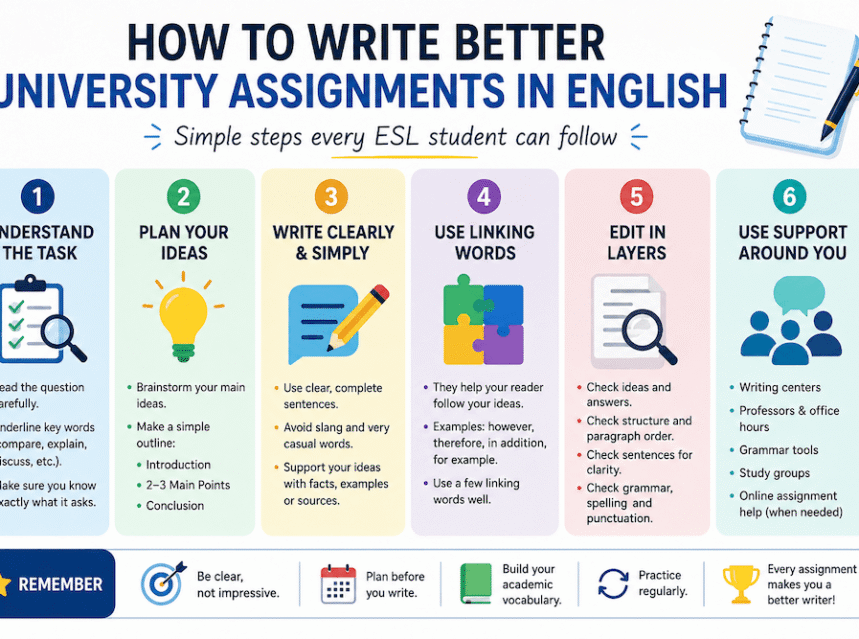
- Read the assignment question carefully.
- Underline important instruction words such as compare, explain, analyze, or discuss.
- Write down your main ideas, even in your native language if it helps.
- Create a simple outline in English with an introduction, body paragraphs, and a conclusion.
When you already know what each paragraph will discuss, writing becomes much easier because you are no longer trying to organize ideas and think about grammar at the same time.
Common Problems ESL Students Face (And How to Fix Them)
1. Translating Word for Word
Thinking in your first language and translating directly into English often produces unnatural sentences.
Instead, try to think in simple English. Even basic English sounds much more natural than a direct translation.
2. Writing Long, Confusing Sentences
If a sentence contains several commas and stretches over multiple lines, readers can easily lose track of your meaning.
Whenever possible, divide long sentences into two shorter ones. This simple habit improves readability immediately.
3. Using Linking Words Incorrectly
Transition words help readers follow your ideas.
Examples include:
- However
- Therefore
- In addition
- For example
Rather than trying to memorize dozens of connectors, learn a small group well and use them correctly.
4. Repeating the Same Words
Academic writing benefits from some variety, but don’t force unusual synonyms.
If a technical term is important, repeating it is often clearer than replacing it with a less accurate word.
Build Your Academic Vocabulary Gradually
You do not need an enormous vocabulary to write well. Instead, focus on learning the words that are commonly used in your subject area.
As you read textbooks and journal articles, notice vocabulary that appears repeatedly. Keep a personal list and learn how those words are naturally used in complete sentences.
Reading quality academic writing is one of the fastest ways to improve your own writing style. Over time, you’ll naturally develop a stronger academic voice.
Know Where to Get Help
You do not have to complete every assignment alone. Universities expect students to use available academic support, and asking for help is a smart strategy.
Useful support options include:
- University writing centers
- Professor office hours
- Grammar and proofreading tools
- Study groups with classmates
- Professional academic support services
When your schedule becomes overwhelming, services that offer help with assignments online can provide support with routine academic writing tasks. The important thing is to use these resources responsibly—to improve your learning and manage your workload rather than avoiding the thinking process that develops your writing skills.
Whatever support you choose, your goal should always be the same: spend more time learning and less time struggling with avoidable obstacles.
Edit in Several Stages
Trying to fix every problem in a single proofreading session is overwhelming. Instead, edit your paper one step at a time.
Read through your assignment several times, each with a different purpose.
- Check whether your ideas answer the assignment question.
- Review the organization of your paragraphs.
- Improve sentence clarity and readability.
- Correct grammar, spelling, punctuation, and formatting mistakes.
Reading your assignment aloud is another effective technique. Your ears often notice awkward wording or missing words that your eyes overlook.
Final Thoughts
Writing university assignments in English is challenging, especially for ESL students, but it is a skill that improves with consistent practice.
Focus on writing clearly rather than trying to sound overly sophisticated. Plan before you write, build your academic vocabulary gradually, revise your work in stages, and use the support available to you whenever necessary.
Every assignment you complete strengthens your confidence and improves your writing skills. Over time, academic English becomes less of an obstacle and more of a powerful tool for communicating your ideas effectively.