How Reading Helps You Learn English Faster
Most people assume speaking is the fastest way to learn English. It isn’t. Reading quietly does something speaking can’t: it lets your brain absorb patterns without the pressure of a live conversation. You can pause. You can reread a sentence three times if you need to. Nobody is waiting for your answer.
This is exactly why the role of reading in learning English keeps coming up in language research. Reading exposes you to grammar, vocabulary, and sentence rhythm all at once, and it does so at your own pace. No other skill offers that combination quite so cleanly.
The Vocabulary Boost Nobody Talks About
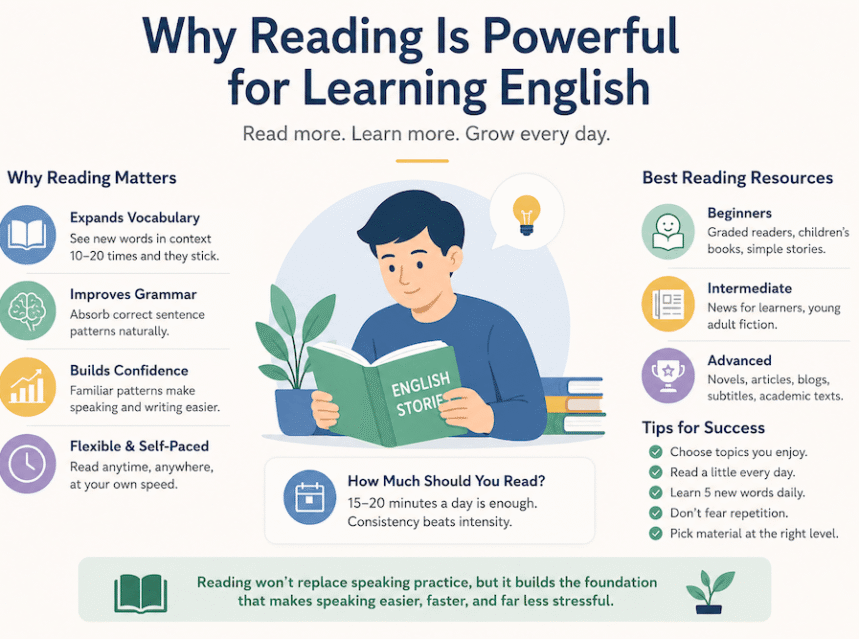
Here’s a number worth remembering: linguists estimate that learners need to see a word somewhere between 10 and 20 times before it truly sticks. Flashcards can get you there, sure, but flashcards are boring, and boring things get abandoned. Reading gets you those repetitions naturally, wrapped inside stories you actually want to finish.
A single novel in your reading app can contain thousands of repeated words in context, not isolated on a card. That context is the part your memory clings to. With FictionMe, you don’t just learn that “gloomy” means sad and dark; you learn what a gloomy Monday morning feels like because you read about someone’s gloomy Monday morning.

Grammar Without the Rules
Nobody enjoys memorizing when to use the present perfect versus the simple past. But readers absorb these patterns almost by accident. After enough exposure, “I have lived here for ten years” simply sounds right, while “I live here since ten years” sounds off, even if you can’t explain the rule.
This is how children learn their first language, and it works for a second one too. Reading rewires your instincts instead of just teaching your memory. Over time, that instinct becomes more reliable than any grammar textbook.
Reading Builds Real Confidence
Confidence is strange. It doesn’t come from knowing rules; it comes from familiarity. When you’ve read hundreds of sentences structured a certain way, new sentences of that same shape stop feeling intimidating.
Learners often say they “understand English but can’t speak it.” Reading is part of the fix. The more your brain recognizes sentence patterns, the faster you can produce them yourself, whether in writing or in conversation.
How Much Should You Read?
Fifteen to twenty minutes a day. That’s it. It sounds small, but consistency beats intensity almost every time. Reading for three hours once a week and then stopping for six days does far less than short daily sessions.
Some researchers suggest that learners who read consistently for pleasure show measurably faster vocabulary growth than those who only study through textbooks and drills. The difference isn’t magic. It’s repetition, spread out, done regularly, without burnout.
English Reading Resources for Beginners
Graded readers are the obvious starting point. These are books written specifically for language learners, using simplified vocabulary and shorter sentences. They exist for almost every level, from absolute beginner to advanced.
Children’s books work surprisingly well too, even for adult learners. Nobody should feel embarrassed about this. Simple stories with repetitive structures and picture context are, honestly, some of the best English reading resources available, precisely because they were designed to teach reading in the first place.
English Reading Resources for Intermediate Learners
Once basic reading feels comfortable, news sites written for learners become useful. Many major news organizations publish simplified versions of their articles specifically for non-native speakers. These keep real-world vocabulary while trimming the complicated grammar.
Young adult fiction is another strong option here. It uses natural, contemporary English without the dense literary style found in classic novels, which makes it far less exhausting to get through.
English Reading Resources for Advanced Learners
At the advanced stage, almost anything becomes fair game: novels, opinion columns, blog posts, even academic articles if the topic interests you. Interest matters more than difficulty at this point. A learner who loves football will push through a complicated sports article faster than a bored learner working through an easy one.
Subtitled content counts too. Reading English subtitles while watching a show trains your eyes and ears simultaneously, which is a surprisingly efficient shortcut most learners underuse.
Fiction or Non-Fiction? Does It Matter?
Not really. Fiction tends to teach dialogue, emotion, and everyday phrasing. An app with thousands of free novellas can be viewed in the App Store and installed in a minute. Non-fiction leans toward structured arguments and factual vocabulary. Both are valuable, and honestly, mixing them keeps things from becoming stale.
Pick whichever keeps you reading. A textbook chosen out of duty gets abandoned after two pages. A messy detective novel chosen out of curiosity gets finished in a weekend.
Turning Reading Into a Daily Habit
Habits form faster when they’re attached to something you already do. Read on the commute. Read before bed instead of scrolling. Read during a coffee break. The specific moment matters less than the consistency of it.
Try keeping a small notebook nearby, or even a notes app, and jot down five new words a day from whatever you’re reading. Just five. Not fifty. Five is sustainable, and sustainable habits are the only ones that survive past week two.
Common Mistakes to Avoid
The biggest mistake? Choosing material that’s too difficult. If you’re stopping every sentence to check a dictionary, you’re not reading anymore, you’re decoding, and decoding is exhausting in a way that kills motivation fast.
The second mistake is skipping repetition. Rereading a favorite short story or article isn’t lazy, it’s efficient. Familiar material lets your brain focus on nuance instead of survival.
Final Thoughts
Reading won’t replace speaking practice, and it shouldn’t try to. But it builds the foundation that makes speaking easier, faster, and far less stressful. Fifteen minutes a day, the right material, and a little patience go a long way.
Start small. Pick something that actually interests you. The rest tends to follow on its own.