You Passed IELTS. Here’s Where You Can Actually Move in 2026
Getting a good IELTS score feels like the hard part. It isn’t.
Thousands of test takers walk away with a solid band score and then spend months confused about what to actually do with it. Which country wants you. Which visa fits your score. Whether you even need residency through skilled migration or if an investment route makes more sense for your situation.
This guide breaks down the real pathways available to IELTS holders in 2026, based on what’s actually changed across Canada, Australia, the UK, and the growing world of golden visas.
Why IELTS Still Matters Beyond the Classroom
IELTS was built as an English proficiency test. But over the past decade, it’s become something bigger: a migration currency.
UK Visas and Immigration still lists IELTS as a Secure English Language Test for study, work, and settlement routes. Canada maps IELTS bands directly onto its Canadian Language Benchmark system for Express Entry. Australia uses IELTS scores to determine whether you qualify for Competent, Proficient, or Superior English, each tier unlocking different points and visa options.
So while your test center probably sold IELTS as a university requirement, the reality is that a meaningful share of candidates are using that score for something much bigger: permanent residency.

The Three Broad Paths After IELTS
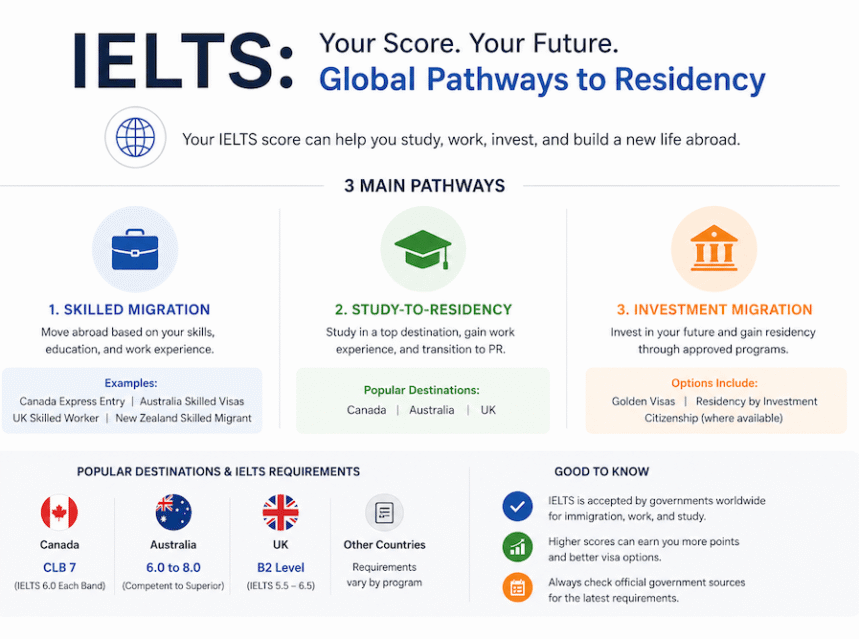
Once you’ve got your score in hand, there are really three directions people take.
Skilled migration is the most direct route. Canada’s Express Entry, Australia’s points-tested skilled visas, New Zealand’s Skilled Migrant Category, and the UK’s Skilled Worker visa all use your English score as a gatekeeping mechanism. Score higher, get more points, receive faster invitations.
Study-to-residency works differently. You study in Canada or Australia, graduate, get a post-study work permit, and eventually transition to permanent residency. This path suits younger applicants who don’t yet have the work experience skilled migration demands.
Investment migration is the third option, and it’s growing fast. The global citizenship and residency by investment market was valued around $9.5 billion in 2025 and is projected to reach $35.8 billion by 2034. This route skips the points system entirely. Instead of proving your English ability translates into a specific occupation, you’re investing capital directly into a country’s economy or property market.
What Your IELTS Score Actually Buys You
Not all bands are equal, and the difference between a 6.0 and an 8.0 can be the difference between a rejected application and a fast-tracked one.
In Australia, a 6.0 across all four skills gets you “Competent English,” the baseline for most skilled visa subclasses. Push that to 7.0 and you’re in “Proficient” territory, worth extra points. Hit 8.0 across the board and you’ve reached “Superior English,” which adds a full 20 points to your skilled migration score.
Canada works on a similar logic but through its CLB system. A Canadian Language Benchmark of 7, roughly equivalent to an IELTS 6.0 in each band, is the minimum for most Federal Skilled Worker applicants. Federal Skilled Trades applicants can get away with slightly lower thresholds.
The UK is tightening things too. Starting January 2026, Skilled Worker, Scale-up, and High Potential Individual visas will require B2-level English across all four skills, which generally maps to an IELTS band somewhere between 5.5 and 6.5 depending on the specific visa route.
One important note for 2026: Australia has restricted accepted English tests to in-person, test-center formats only. Fully online versions like IELTS Online no longer count for visa purposes. If you’re testing specifically for migration, book an in-person exam.
When Skilled Migration Isn’t the Right Fit
Not every IELTS holder wants to compete in a points system, and not everyone qualifies for one anyway. This is where residency and citizenship by investment programs come into play, and 2026 has brought some significant shifts.
The EU has effectively closed the door on direct citizenship by investment. Malta’s scheme was ruled unlawful and withdrawn. What remains is residency by investment followed by naturalisation after several years of physical presence and language requirements, usually in the local tongue rather than English.
Portugal’s Golden Visa is still active but has moved away from property purchases entirely. Investment now flows through regulated funds starting around €500,000, or cultural and R&D projects starting from €250,000. Citizenship requires seven to ten years of residency depending on nationality, plus A2-level Portuguese.
Greece raised its Golden Visa thresholds significantly in 2024, now sitting at €800,000 in prime areas like Athens and the islands, or €400,000 elsewhere. Despite the higher bar, Greece received over 9,000 applications in 2024 alone, a 10% increase from the year before.
Spain closed its classic Golden Visa property route entirely under a 2025 law, though non-lucrative and digital nomad visas remain available for those with sufficient income.
Malaysia has taken a different approach, revamping its MM2H program into three tiers (Silver, Gold, Platinum) with fixed deposits ranging from $150,000 to $1,000,000, plus mandatory property purchases. The program generated close to RM3.9 billion in economic value in 2025 alone, showing just how much appetite there is for Asian residency options among global investors.
Digital Nomad Visas: The Middle Ground
For IELTS holders who work remotely but aren’t ready to invest six figures into a golden visa, digital nomad visas have become the practical middle path.
Portugal’s D8 visa requires proof of remote income around €3,280 to €3,480 per month in 2025, alongside savings equal to roughly twelve times the minimum wage. No investment required, just proof you can support yourself while working from Lisbon or Porto.
These visas don’t typically require a formal IELTS score, but having strong English documentation of your income and employment history makes the application process considerably smoother.
Choosing Between Skilled Migration and Investment Routes
The honest answer depends on your financial position and your timeline.
If you have in-demand skills, a competitive occupation, and a strong IELTS score, skilled migration to Canada or Australia often gets you permanent residency faster and cheaper than any investment route. You’re trading time and effort for a lower financial barrier.
If you have capital but your occupation doesn’t score well on points systems, or you simply want faster access to European lifestyle and mobility without waiting years for points-based invitations, golden visas and residency by investment programs solve a different problem entirely.
Given how quickly these programs change (Portugal, Greece, and Spain have all overhauled their rules within the last two years) working with someone who tracks these shifts daily makes a real difference. This is precisely the kind of complexity where Global Residence Index has built its reputation, helping applicants match their financial profile and timeline to the right program rather than guessing based on outdated blog posts.
Whichever path fits your situation, the message for 2026 is clear. IELTS is no longer just a study requirement. It’s a genuine gateway to residency, provided you understand which door it actually opens.