50+ Business English Words and Phrases for Work (Free PDF)
Want to sound more professional in English? You don’t need difficult grammar or a perfect accent. In most workplaces, the difference comes down to vocabulary. Choosing more precise words can help you communicate more confidently in meetings, job interviews, presentations, and everyday business conversations.
This guide teaches professional English vocabulary for work: useful sentence upgrades, common business phrases, and practical examples. It suits intermediate (B1) learners and above. You can also download a free printable PDF to review everything offline.
In this guide you will learn:
- 50 everyday words and their professional alternatives, with examples
- When to use formal, neutral or informal words
- 15 sentence upgrades and 20 key professional verbs
- 15 business phrases (collocations) used in meetings, emails and interviews
- A practice exercise and a mini quiz with answers
50 Basic English Words vs Professional English
The words below are common in business English, professional emails, meetings, reports, and job interviews. Each word is paired with a short example phrase so you can learn it in context. Professional words are best suited to formal situations. In everyday conversations, simpler words are often the better choice.

Verbs: 25 Everyday Words and Their Professional Alternatives
| Everyday word | Professional word | Example |
|---|---|---|
| Buy | Purchase | purchase new software |
| Help | Assist | assist a customer |
| Need | Require | require approval |
| Get | Obtain | obtain permission |
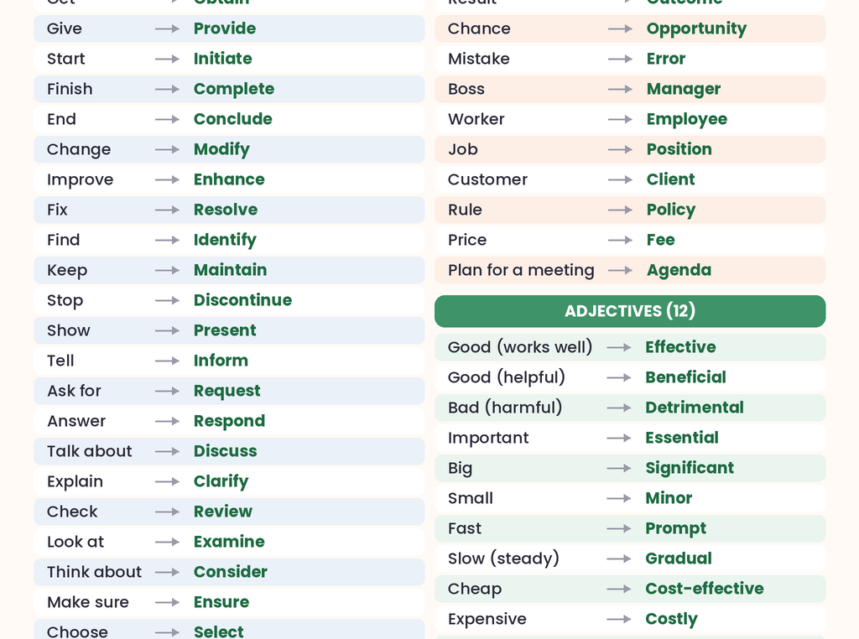
| Give | Provide | provide feedback |
| Start | Initiate | initiate a project |
| Finish | Complete | complete the task |
| End | Conclude | conclude the meeting |
| Change | Modify | modify the proposal |
| Improve | Enhance | enhance performance |
| Fix | Resolve | resolve an issue |
| Find | Identify | identify the cause |
| Keep | Maintain | maintain good relationships |
| Stop | Discontinue | discontinue a service |
| Show | Present | present the results |
| Tell | Inform | inform the team |
| Ask for | Request | request more information |
| Answer | Respond | respond to an email |
| Talk about | Discuss | discuss the budget |
| Explain | Clarify | clarify the process |
| Check | Review | review the contract |
| Look at | Examine | examine the data |
| Think about | Consider | consider all options |
| Make sure | Ensure | ensure accuracy |
| Choose | Select | select a supplier |
Nouns: 13 Everyday Words and Their Professional Alternatives
| Everyday word | Professional word | Example |
|---|---|---|
| Problem | Issue | report an issue |
| Idea | Proposal | submit a proposal |
| Goal | Objective | achieve an objective |
| Result | Outcome | a positive outcome |
| Chance | Opportunity | identify opportunities |
| Mistake | Error | correct an error |
| Boss | Manager | report to the manager |
| Worker | Employee | a new employee |
| Job | Position | apply for a position |
| Customer | Client | meet a client |
| Rule | Policy | follow company policy |
| Price | Fee | pay a service fee |
| Plan for a meeting | Agenda | send the agenda |
Adjectives: 12 Everyday Words and Their Professional Alternatives
| Everyday word | Professional word | Example |
|---|---|---|
| Good (works well) | Effective | an effective solution |
| Good (helpful) | Beneficial | a beneficial change |
| Bad (harmful) | Detrimental | detrimental to the business |
| Important | Essential | essential skills |
| Big | Significant | a significant increase |
| Small | Minor | a minor issue |
| Fast | Prompt | a prompt reply |
| Slow (steady) | Gradual | gradual improvement |
| Cheap | Cost-effective | a cost-effective option |
| Expensive | Costly | a costly mistake |
| Hard | Challenging | a challenging project |
| Easy | Straightforward | a straightforward process |
Teacher’s Tip: Don’t try to replace every simple word with a formal one. Native speakers often choose the simplest word that sounds natural. Use professional vocabulary mainly in formal situations such as meetings, interviews, presentations, reports, and business emails.
Informal, Neutral or Formal? Choosing the Right Word
Many everyday words are perfectly fine at work. The right choice depends on who you are writing or speaking to and how formal the situation is. Use neutral words for most emails and meetings, and formal words for contracts, reports and official letters.
| Informal | Neutral | Formal |
|---|---|---|
| get | receive | obtain |
| buy | buy | purchase |
| ask for | ask for | request |
| need | need | require |
| help | help | assist |
| talk about | discuss | address |
Note: You may see use → utilize on vocabulary lists, but use is almost always the better choice. Utilize sounds heavy and is rarely needed in everyday business English.
Upgrade Your Everyday Sentences
You don’t always need advanced grammar to sound more professional. Sometimes replacing a few words, or making a request more polite, makes a big difference.
| Instead of… | Try saying… |
|---|---|
| I think this is better. | In my view, this is the better option. |
| I want to talk to you. | I would like to discuss something with you. |
| I’ll check it. | I’ll review it. |
| Can you help me? | Could you assist me? |
| We fixed the problem. | We resolved the issue. |
| We finished the report. | We completed the report. |
| Send me the document. | Could you please send me the document? |
| I’ll tell the manager. | I’ll inform the manager. |
| I found a problem. | I identified an issue. |
| The results were good. | The results were very positive. |
| We need more money. | We require additional funding. |
| I don’t agree. | I see it a little differently. |
| Sorry, I can’t come. | Unfortunately, I won’t be able to attend. |
| What do you mean? | Could you clarify what you mean? |
| We need more time. | We would need some additional time. |
Quick Learning Tip: Learn complete phrases instead of individual words. It’s easier to remember “resolve an issue” than simply memorizing the word “resolve.”
Professional Verbs You Should Know
These 20 verbs appear frequently in business English, reports, presentations, and professional conversations. Each one is shown with a common phrase.
Analysis and Evaluation
- Analyze — analyze sales data
- Assess — assess the risks
- Evaluate — evaluate a candidate
- Review — review the contract
- Identify — identify the cause
Communication
- Communicate — communicate clearly with clients
- Present — present the quarterly results
- Recommend — recommend a solution
- Negotiate — negotiate a price
- Facilitate — facilitate a workshop
Action and Delivery
- Coordinate — coordinate the schedule
- Deliver — deliver the project on time
- Implement — implement a new process
- Develop — develop a training plan
- Establish — establish clear goals
Improvement and Support
- Enhance — enhance the customer experience
- Improve — improve efficiency
- Maintain — maintain high standards
- Assist — assist new colleagues
- Resolve — resolve a complaint
Common Business English Phrases
Professional English is about more than individual words. Native speakers often use common word combinations, known as collocations, to communicate naturally in the workplace. Learning these phrases will help your English sound more fluent and professional.
| Business phrase | Meaning | Example |
|---|---|---|
| Meet a deadline | Finish work on time. | We must meet the deadline on Friday. |
| Achieve an objective | Successfully reach a goal. | The team achieved its sales objective. |
| Conduct research | Carry out research or investigation. | We conducted research on customer needs. |
| Provide feedback | Give comments or suggestions. | Please provide feedback on the draft. |
| Reach an agreement | Agree on terms or a decision after discussion. | We hope to reach an agreement this week. |
| Negotiate a contract | Discuss and finalize contract terms. | She negotiated a contract with a new supplier. |
| Submit a proposal | Send a formal plan or suggestion for approval. | I submitted a proposal to the board. |
| Identify opportunities | Recognize possible advantages. | We need to identify opportunities for growth. |
| Improve performance | Increase efficiency or results. | Training can improve performance. |
| Increase productivity | Produce more in less time. | New software increased productivity. |
| Reduce costs | Lower business expenses. | We reduced costs by 10%. |
| Resolve an issue | Solve a problem. | Support resolved the issue quickly. |
| Establish relationships | Build professional connections. | It takes time to establish relationships with clients. |
| Deliver results | Produce successful outcomes. | The new manager delivered results in six months. |
| Exceed expectations | Perform better than expected. | The project exceeded expectations. |
Teacher’s Tip: Try learning vocabulary as phrases instead of individual words. For example, it’s easier to remember meet a deadline than memorizing the verb meet on its own.
Professional Communication Examples
Here are some simple examples showing how small changes in vocabulary and tone can make your English sound more professional. For more speaking practice, see our conversational English lessons, and for writing, our English writing lessons.
During a Meeting
Basic: Let’s start. First, I’ll talk about sales.
Professional: Let’s begin with the agenda. First, I’ll go over the sales figures.
Why it works: It follows a clear structure and uses more precise verbs.
Giving a Presentation
Basic: Today I’ll show our results.
Professional: Today I’ll present our quarterly results.
Why it works: Present is the standard verb for formal talks, and quarterly makes the topic specific.
Speaking on the Phone
Basic: I don’t know yet. I’ll tell you later.
Professional: I don’t have that information yet. I’ll get back to you this afternoon.
Why it works: It sounds polite and gives a clear time for your answer.
Job Interview
Basic: I helped customers with technical problems.
Professional: I resolved technical issues for customers.
Why it works: Resolved shows a result, which interviewers like to hear.
Business Email
Basic: I’ll check the report.
Professional: I’ll review the report and get back to you by Friday.
Why it works: It names the action and the deadline.
Common Mistakes: Many learners believe that using longer words always sounds more professional. In reality, native speakers often choose the clearest and most natural expression.
1. Review is a good choice in a business email, but check is also fine in a quick message.
2. Use is usually more natural than utilize.
3. Don’t copy written phrases into speech. “It is necessary to” works in a report, but “We need to” sounds more natural in a meeting.
Practice Exercise
Replace the bold words with more professional alternatives from this lesson. Change the verb form if the sentence needs it.
- We need to buy new software.
- Could you help me with this report?
- Please check the document before sending it.
- We need to find the cause of the delay.
- The team fixed the problem quickly.
- Our main goal is customer satisfaction.
- We finished the report on Friday.
- Please tell the manager about the update.
- She will ask for more information.
- We talked about the budget yesterday.
Answer Key
- purchase
- assist
- review
- identify
- resolved
- objective
- completed
- inform
- request
- discussed
Mini Quiz
Choose the word that completes each business phrase correctly.
- We hope to ___ an agreement by Friday.
A) hold
B) reach
C) catch - Please ___ feedback on the draft.
A) say
B) speak
C) provide - The team quickly ___ the problem.
A) resolved
B) closed
C) lifted - She will ___ the quarterly results at the meeting.
A) hear
B) present
C) look - We need to ___ costs this year.
A) lose
B) fall
C) reduce
Quiz Answers
- B) reach — We say reach an agreement.
- C) provide — Provide feedback is the standard business collocation.
- A) resolved — We resolve a problem or an issue.
- B) present — We present results, a report or a plan.
- C) reduce — We reduce costs, not lose them.
Want to check your overall level before moving on? Try our English level test or browse more English vocabulary lessons.
Download the Free PDF
Want to review this lesson offline? Download the printable PDF to get:
- 100 professional English words and phrases: 50 word pairs, 20 verbs, 15 sentence upgrades and 15 business phrases
- A printable vocabulary list
- A practice exercise with answer key
- A mini quiz
Professional English Vocabulary PDF – Download
Frequently Asked Questions
What is professional English?
Professional English is the language commonly used in workplaces, business meetings, presentations, reports, job interviews, and professional emails. It focuses on clear, polite, and precise communication.
Is professional English the same as business English?
The two terms overlap a lot. Business English usually refers to the vocabulary and phrases used in companies, such as contracts, meetings and negotiations. Professional English is a wider term for workplace communication in any job.
Should I always use professional vocabulary?
No. Professional vocabulary works best in formal situations. When talking with friends or family, simple English usually sounds more natural.
Is “utilize” more professional than “use”?
Not really. Utilize sounds formal but also heavy, and native speakers usually prefer use, even in business writing.
How can I remember professional English words?
Instead of memorizing long vocabulary lists, learn words in context. Read business articles, listen to workplace conversations, and practice using new words in your own sentences.
How many new words should I learn each week?
Five to ten new words per week is a realistic goal for most learners. Focus on using them in speaking and writing rather than simply memorizing their definitions.
Is this vocabulary useful for job interviews?
Yes. Many of the words and phrases in this guide are commonly used during job interviews, workplace conversations, presentations, and business communication.