15 Horse Racing Idioms and Expressions Used in Everyday English
Have you ever said “we’re in the home stretch” or called someone a “dark horse”? You probably weren’t thinking about a racetrack, but you were using horse racing language.
Horse racing has its own vocabulary, and quite a few of its expressions escaped the track and became part of ordinary conversation. Some are so familiar that their original meaning is easy to miss.
First, What Do These Expressions Mean at the Track?
Racing language describes what happens during a race and how people judge the runners before it starts. The same terms appear everywhere, from race reports to expert previews.
For example, when you read horse racing picks by TwinSpires, the analysts use terms like front-runner, long shot, favorite, and neck and neck to describe how a race might unfold. Knowing what these words mean on the track makes the discussion much easier to follow.
What’s surprising is how many of these phrases we use in everyday English without thinking about horse racing at all.
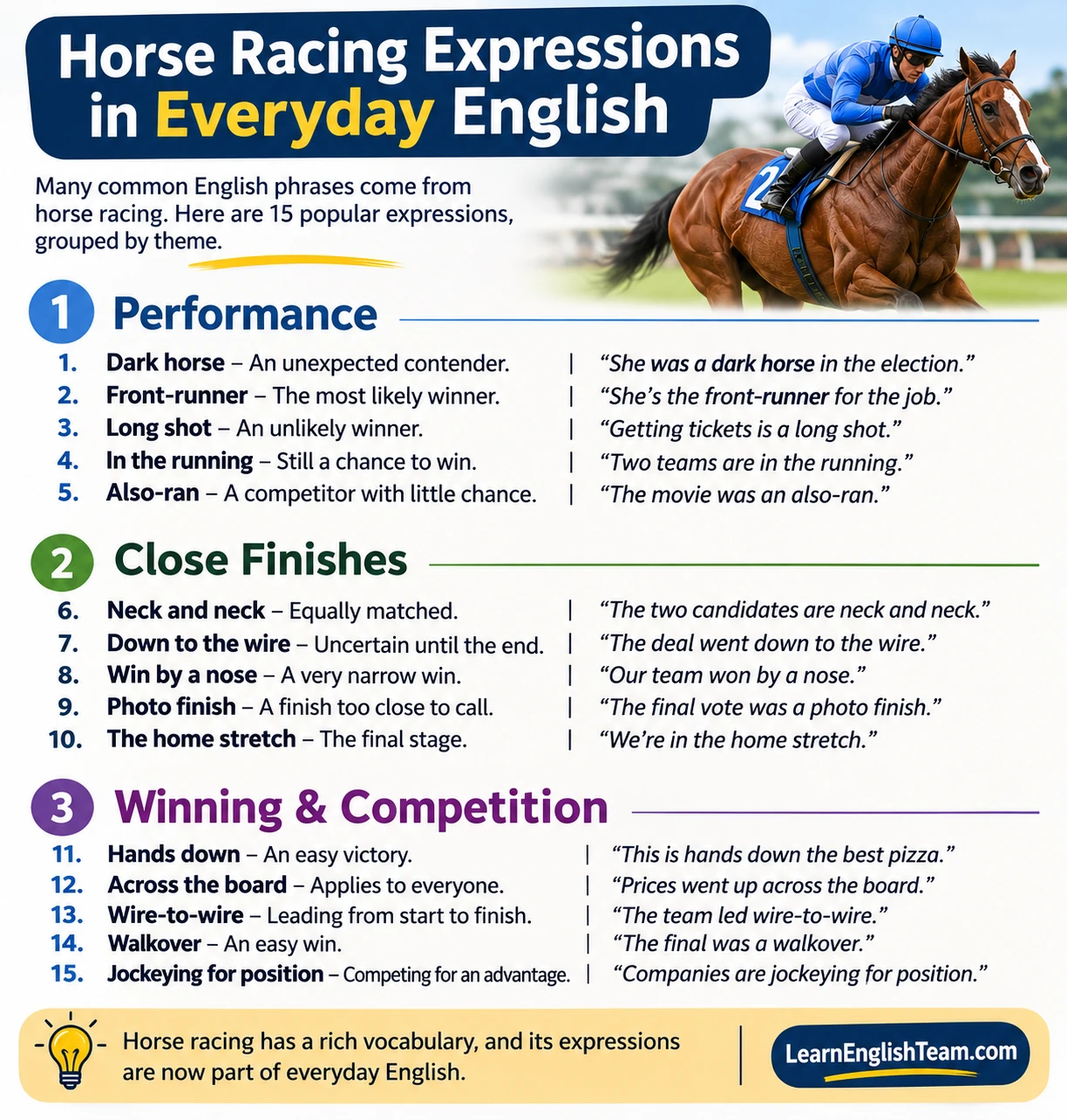
Horse Racing Expressions Based on Performance
- Dark horse. An unfamiliar contender whose ability isn’t widely known. The phrase appears in nineteenth-century racing writing and now describes anyone who turns out to be unexpectedly competitive. It doesn’t refer to the horse’s coat color.
Example: “Nobody expected her to win the election, but she was a dark horse.” - Front-runner. A horse that usually runs at the front and sets the pace. In everyday English, it means whoever seems most likely to succeed, such as the top candidate for a job.
Example: “She’s the front-runner for the manager position.” - Long shot. A runner considered unlikely to win. Outside racing, it’s an unlikely possibility worth attempting anyway. The expression also draws on distant-target shooting, so its history isn’t exclusively equestrian.
Example: “Getting tickets this late is a long shot, but let’s try.” - In the running. A horse still has a chance of competing successfully. Today, it describes anyone still being considered for a job or opportunity.
Example: “Two cities are still in the running to host the event.” - Also-ran. Racing results traditionally separated the leading finishers from horses that merely “also ran.” Now it’s an unflattering label for someone who competed but made little impact.
Example: “The new phone was an also-ran in a crowded market.”
Expressions About Close Finishes
- Neck and neck. Picture two horses running alongside one another with neither gaining ground. The phrase now describes equally matched competitors in almost any field.
Example: “The two candidates are neck and neck in the polls.” - Down to the wire. As language historian Michael Quinion explains, a wire above the finish helped judges identify the winner. Today, it means the outcome stays uncertain until the very end.
Example: “The contract talks went down to the wire.” - Win by a nose. A nose is the smallest official winning margin in racing. Beyond the track, it means winning something by the narrowest possible difference.
Example: “Our team won the quiz by a nose.” - Photo finish. As the Cambridge Dictionary explains, judges sometimes need a finish-line photograph to separate horses. We use it whenever two competitors are almost impossible to separate.
Example: “The final vote was a photo finish.” - The home stretch. The final straight section of a racecourse leads to the finish. Now it describes the last stage of any long task.
Example: “We’re in the home stretch with this project.”
Expressions About Winning and Competition
- Hands down. Great British Racing explains that a jockey with a comfortable lead could lower their hands and ease the reins. That’s how “winning hands down” came to mean winning easily.
Example: “This is hands down the best pizza in town.” - Across the board. In American racing, a bet across the board covers a horse to win, place, and show. In everyday conversation, it means something applies to everyone or everything.
Example: “Prices went up across the board this year.” - Wire-to-wire. A horse leading from start to finish wins wire-to-wire. It’s now used for any contest where someone stays ahead throughout.
Example: “The team led wire-to-wire and never looked back.” - Walkover. In horse racing, a walkover occurs when only one horse remains to contest the race. Today, we use the expression for any exceptionally easy victory.
Example: “The final was a walkover for the home team.” - Jockeying for position. Jockeys work to secure a favorable place in a race. The phrase now describes competitors maneuvering for an advantage, especially before the real contest begins.
Example: “Several companies are jockeying for position in the new market.”
Final Thoughts
Some of these phrases kept their original racing meaning, while others drifted far from the track. Few people who say “hands down” today picture a jockey easing the reins.
Horse racing has been popular for centuries, so it’s no surprise its language became part of everyday English. Next time you hear one of these idioms, you’ll know where it started.