20 Printable English Grammar Posters (Free PDF)
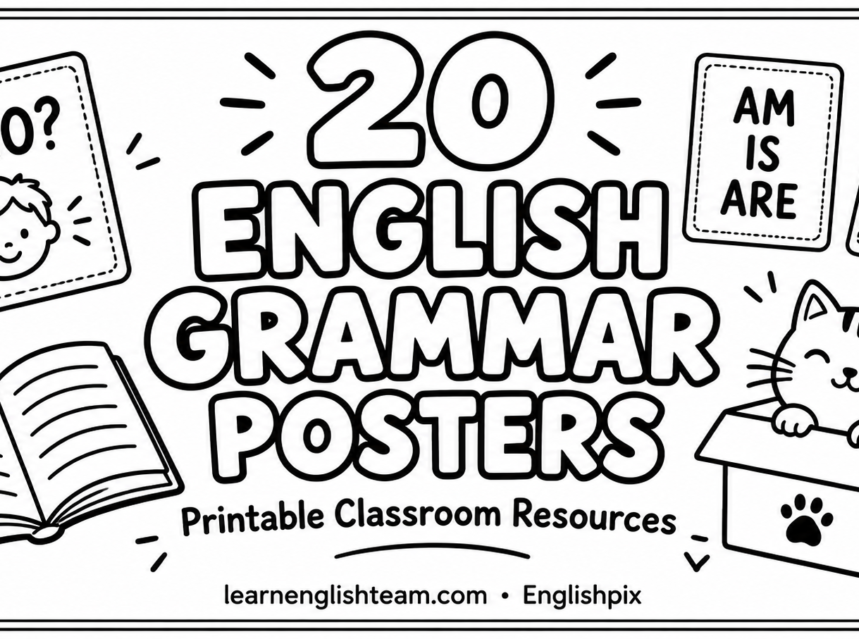
Need a quick visual for your grammar lesson? These 20 free printable English grammar posters use simple examples and clear line drawings to help beginners understand a topic at a glance. They are black and white, so they are easy to print and photocopy.
Download any poster by right-clicking its picture, or get the complete PDF in A4 or US Letter at the end of the page. Each PDF has 20 pages, one poster per page, with white margins so nothing gets cut off when you print.
Under every poster, you’ll find a quick classroom activity and a teaching tip. Use what fits your class and skip the rest.
1. Question Words
Use who for people, what for things or information, where for places, when for times, why for reasons, which for a choice, and how for a way or method. The pictures give beginners a starting point for making questions.
Quick classroom activity: Put a familiar classroom object in a bag. Partners take turns choosing a question word and asking a question about it. Model a complete question first.
- What is in the bag? A book.
- Where is the book? It is in the bag.
Teaching tip: Start with two or three question words before introducing the full poster.
2. Prepositions of Place
This poster shows in, on, under, next to, behind, and in front of. Help learners describe the relationship between two objects rather than memorizing an isolated word.
Quick classroom activity: Move a toy and a box into three positions. Students describe each position, then work in pairs: one gives an instruction and the other moves the toy.
- The cat is in the box.
- Put the pencil next to the book.
Teaching tip: Use the same viewpoint for behind and in front of so the position is clear.
3. Prepositions of Time
Use at with clock times, on with days and dates, and in with months, seasons, and years. The poster also includes common expressions such as at night. These patterns help learners build a simple daily or weekly schedule.
Quick classroom activity: Write 7:00, Monday, January, and summer on the board. Partners add the correct preposition and use one expression in a sentence about their lives.
- The lesson starts at 7:00.
- We play on Monday.
- My birthday is in January.
Teaching tip: Explain common expressions separately; do not turn these patterns into a rule without exceptions.
4. Subject Pronouns
I, you, he, she, it, we, and they can replace a noun or noun phrase as the subject of a sentence. We includes the speaker; they refers to other people or things.
Quick classroom activity: Point to yourself, a pair including yourself, and a separate group. Learners choose I, we, or they. Next, replace familiar names in short board sentences with pronouns.
- Mia is my friend. She is my friend.
- Sam and I are a team. We are a team.
Teaching tip: Use it for a single thing or an animal when appropriate, and they for plural people or things.
5. The Verb Be: Am, Is and Are
Match I with am; he, she, and it with is; and you, we, and they with are. Add not for a negative sentence. In a question, put am, is, or are before the subject.
Quick classroom activity: Give pairs three subject cards and three be cards. Students make a correct match, say an affirmative sentence, then change it to a negative or a question.
- I am happy. I am not tired.
- She is ready. Is she ready?
- They are friends. Are they friends?
Teaching tip: Model both word order and meaning. A negative sentence should match the situation being described.
6. Articles: A, An and The
Use a or an with a singular countable noun when introducing one thing. Choose a or an by the following sound: a university starts with a consonant sound, while an hour starts with a vowel sound. Use the when the listener can identify the thing you mean.
Quick classroom activity: Show a picture of a dog and introduce it. Add a second sentence about the same dog. Then ask pairs to repeat the pattern with a familiar object.
- I see a dog. The dog is small.
- a book; an apple; a university; an hour
Teaching tip: Ask learners to listen to the sound, rather than look only at the first letter.
7. Singular and Plural Nouns
Compare one item with more than one. The poster includes regular endings and irregular forms: cat/cats, book/books, box/boxes, baby/babies, child/children, and foot/feet.
Quick classroom activity: Place one pencil on a desk, then add another. Students say both forms. Give pairs one regular and one irregular noun from the poster and ask them to make a new example.
- one box; two boxes
- one baby; two babies
- one child; two children
Teaching tip: For baby, change consonant + y to ies. Do not apply this spelling change to words such as boy.
8. Action and State Verbs
Action verbs such as run, read, and jump describe actions. State verbs such as like, love, and know commonly describe feelings, thoughts, or states. This is a useful first contrast, though some verbs change meaning in different uses.
Quick classroom activity: Students mime run, read, or jump while classmates identify the verb. Then switch to speaking prompts: name something you like or something you know.
- I read books.
- I like apples.
- I know the answer.
Teaching tip: State verbs are often used in simple forms. Avoid teaching that every such verb is impossible in a continuous form.
9. Adjectives and Opposites
Use paired pictures to explore big/small, hot/cold, happy/sad, tall/short, fast/slow, and clean/dirty. Learners can first name the quality and then use it in a complete sentence.
Quick classroom activity: Choose two suitable classroom objects or draw a pair on the board. Ask students to describe each with an opposite adjective. For feelings, students can draw faces instead of describing classmates.
- The tree is tall. The bush is short.
- The shirt is clean. The other shirt is dirty.
Teaching tip: Use objects, drawings, or animals for size comparisons rather than comparing students’ bodies.
10. Conjunctions: And, But and Or
And adds information, but introduces a contrast, and or presents a choice in the examples on this poster. Start with short, meaningful sentences before asking learners to join longer ideas.
Quick classroom activity: Write two short ideas: I have a cat. I have a dog. Ask pairs to join them with and. Next, show a small heavy bag and offer a choice between two drinks.
- I have a cat and a dog.
- The bag is small but heavy.
- Would you like tea or juice?
Teaching tip: Choose the conjunction for the meaning you want; these three words are not interchangeable.
11. English Tenses: Six Useful Forms
This overview presents six selected forms: present simple, present continuous, past simple, past continuous, present perfect, and future with will. Each has one representative use; the poster is not a complete guide to every English tense or use.
Quick classroom activity: Display only the two forms your class is studying. Read a sentence and ask learners to connect it to a habit, something happening now, or a completed past event. Expand to the other cards when appropriate.
- I read every day. I am reading now.
- I played yesterday. I was reading at 8 p.m.
- I have lost my key. I will help you.
Teaching tip: Present perfect can connect a past event to a present result. Will can express an immediate decision; it has other uses too.
12. This, That, These and Those
Use this and that with one thing, and these and those with more than one. This and these commonly point to things near the speaker; that and those point to things farther away.
Quick classroom activity: Keep one book near you and another across the room. Add a group of pencils nearby. Students point and describe, then take turns becoming the speaker.
- This is a book. That is a kite.
- These are my pencils. Those are birds.
Teaching tip: What counts as near or far depends on the speaker and the situation.
13. Possessive Adjectives
My, your, his, her, its, our, and their come before nouns to connect things with people, animals, or groups. They do not change form to match a singular or plural object.
Quick classroom activity: Give each pair a few labelled classroom objects. Students describe their own object, their partner’s object, and a shared object, using my, your, and our.
- This is my book. These are my books.
- Her bike is new. Their house is small.
- The cat has a tail. Its tail is long.
Teaching tip: Its has no apostrophe when it shows possession. It’s is a contraction of it is or it has.
14. There Is and There Are
Use there is to introduce one countable thing or an uncountable amount, and there are for plural countable things. The apple pictures show affirmative sentences, negatives, questions, and short answers.
Quick classroom activity: Show students a tray with two pencils and one book. Cover it, then ask pairs to describe what they remember. Uncover it so they can check their sentences.
- There is a book. There are two pencils.
- Is there an apple? Yes, there is.
- There is some water in the glass.
- There is not an apple. There are not any apples.
Teaching tip: The poster focuses on singular and plural apples. Add an uncountable example once that distinction is secure.
15. Have and Has
For possession, use have with I, you, we, and they. Use has with he, she, and it. The pictures help learners connect each subject with an object or feature.
Quick classroom activity: Students draw an imaginary animal with an unusual feature, such as a long tail. Partners describe the drawing with it has. Then students say one thing they have in their school bags.
- I have a book. We have a ball.
- He has a kite. She has a cat.
- It has a long tail.
Teaching tip: If you extend to questions and negatives, model does he have and he does not have, using the base form have.
16. Can and Can’t
Can and can’t are followed by a base verb. The verb does not take s after can, even with he or she. Use can before the subject to ask about an ability.
Quick classroom activity: Pairs choose a familiar skill, such as swimming or riding a bike. One asks a question and the other gives a short answer. Learners can answer for an imaginary character if they prefer.
- I can swim. I can’t fly.
- Can you ride a bike? Yes, I can.
- She can jump.
Teaching tip: Keep the focus on the language; students do not need to demonstrate a physical skill.
17. Countable and Uncountable Nouns
Countable nouns have singular and plural forms, such as an apple and two apples. Water, rice, and milk are usually uncountable in the everyday meanings shown here. Containers or amounts let us describe quantities.
Quick classroom activity: Sort picture cards into the two groups. Ask learners to count the apples and books, then add a container phrase to water or rice.
- three books; four eggs
- some water; a glass of water
- some rice; a bowl of rice
Teaching tip: A glass is countable even though water is uncountable. Some nouns have other countable meanings in different contexts.
18. Some and Any
Some is common in affirmative sentences; any is common in negatives and questions. Some also appears in offers and requests, such as Would you like some water? These are useful starting patterns, not the only possible uses.
Quick classroom activity: Draw an empty bowl and a bowl with apples. Pairs describe each one, ask about the contents, and then practise offering or requesting a drink.
- There are some apples. There aren’t any apples.
- Are there any apples?
- Can I have some water, please?
Teaching tip: Do not mark some as wrong simply because it appears in a question. Check what the speaker means.
19. Comparatives and Superlatives
Use a comparative to compare, often with than: taller than. Use a superlative to identify the highest degree within a group: the tallest. The poster also shows the spelling of bigger/biggest and the irregular forms better/best.
Quick classroom activity: Draw three trees of different heights. Ask students to compare two trees, then identify the tallest in the group. Let pairs create a second set of drawings for another comparison.
- This tree is taller than that tree.
- This is the tallest tree.
- good; better; the best
Teaching tip: The test scores illustrate good, better, and best within a simple comparison; they do not define a student’s overall ability.
20. Adverbs of Frequency
Always, usually, often, sometimes, and never describe how often something happens. They usually come before a main verb and after the verb be. The check symbols show relative frequency, not fixed percentages.
Quick classroom activity: Students write one routine sentence using a frequency adverb. Partners read each other’s sentences and check the position of the adverb. Offer an imaginary character as an alternative to sharing personal routines.
- I often read after school.
- I sometimes play tennis.
- She is always kind.
Teaching tip: Sometimes can also begin a sentence: Sometimes I play tennis. Start with one consistent pattern before introducing other positions.
Download the PDF
Download 20 Printable English Grammar Posters for Your Classroom — A4 PDF
Download all grammar posters — US Letter PDF