
How to Use the Verb ‘Get’ in English: 10 Common Meanings with Examples
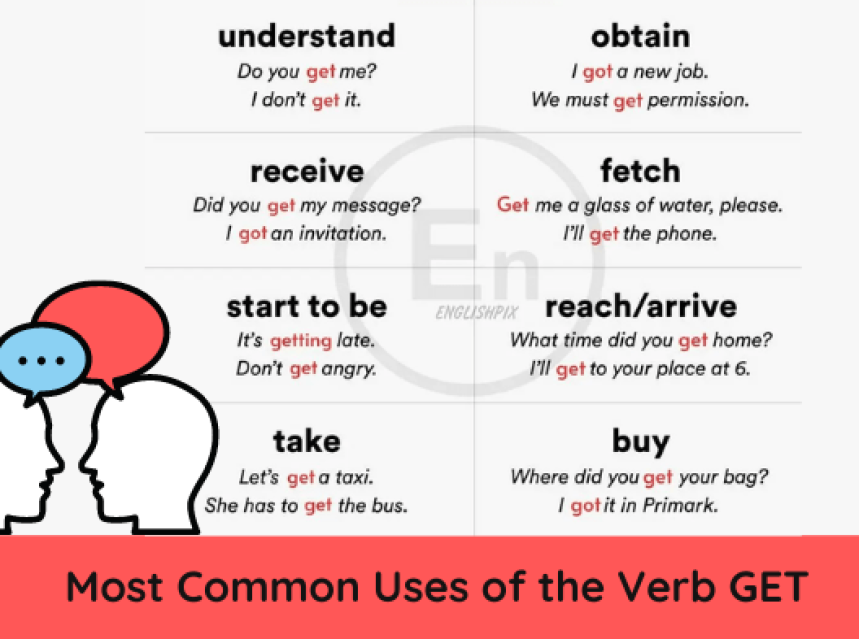
The verb get is one of the most common words in English. Native speakers use it every day, in almost every conversation. But for many English learners, “get” can be confusing because it has more than 30 different meanings. The good news? You only need to learn a few of the most common ones first.
In this lesson, you will learn the 10 most common meanings of “get” with clear examples. By the end, you will know how to use get correctly in daily English conversations.

Is “Get” Formal or Informal?
“Get” is informal. It is perfect for speaking, texting, and everyday writing. However, in essays, reports, emails to your boss, and other formal writing, it is better to use a more specific verb. For example:
- Informal: I got your message. → Formal: I received your message.
- Informal: We got to the hotel at 6 p.m. → Formal: We arrived at the hotel at 6 p.m.
Tip: The forms of the verb are get → got → got (British English) or get → got → gotten (American English). So, got is the past simple of get, and both got and gotten can be the past participle, depending on the English you use.
10 Common Meanings of “Get” with Examples
Study the table below. Read each example aloud and try to make your own sentence with each meaning.
| Meaning | Example Sentences |
|---|---|
| arrive (reach a place) | I got home later than usual yesterday. What time did you get to the airport? |
| receive | He got a car for his birthday. I got a text from my sister this morning. |
| earn (make money) | I get $12 an hour. She gets a good salary at her new job. |
| bring or fetch | Can you get that chair for me? I’ll get you a glass of water. |
| understand | Do you get his jokes? Sorry, I don’t get it. Can you explain again? |
| become (change into a state) | It’s getting dark. Let’s go home. He got angry when he heard the news. |
| catch (an illness) | She got a cold last month. Wear a jacket, or you’ll get sick. |
| catch or take (transport) | He gets the train to work every day. We got a taxi to the station. |
| contact or reach (someone) | I got in touch with him by email. You can get me on my mobile phone. |
| affect (have a strong emotional effect on) | Her wise words really got to me. That sad movie got me. I cried at the end! |
| capture or catch (a person) | The police got him at the station. They finally got the thief. |
Common Patterns with “Get”
“Get” is also used in many useful patterns. Learn these and your English will sound more natural.
- get + adjective (become): get tired, get hungry, get better, get cold
I get tired after work. - get + past participle (passive meaning): get married, get lost, get fired, get invited
They got married in June. - get + noun (receive or obtain): get a job, get an answer, get a ticket
She got a job at a bank. - get + to + verb (have the chance): We got to meet the actor after the show.
Popular Phrasal Verbs with “Get”
| Phrasal Verb | Meaning | Example |
|---|---|---|
| get up | leave your bed | I get up at 7 a.m. |
| get along (with) | have a good relationship | I get along with my neighbors. |
| get over | recover from something | She got over the flu quickly. |
| get back | return | We got back from vacation yesterday. |
| get on / get off | enter / leave a bus, train, or plane | I got off the bus at the next stop. |
Common Mistakes with “Get”
- Incorrect: He gets the train to
homeevery day.
Correct: He gets the train home every day. (No “to” before “home”) - Incorrect: I
have gotan email yesterday.
Correct: I got an email yesterday. (Use the past simple with “yesterday”) - Incorrect: I
gethome at 6 yesterday.
Correct: I got home at 6 yesterday. (Use “got” for the past)
Quick Practice
Choose the correct meaning of get in each sentence.
- I didn’t get the joke. → (a) receive (b) understand
- It’s getting cold outside. → (a) becoming (b) arriving
- What time do you get to work? → (a) arrive at (b) earn
Answers: 1-b, 2-a, 3-a

Summary
The verb get is flexible, common, and very useful. Remember that it can mean arrive, receive, earn, bring, understand, become, catch, contact, affect, and capture. Use it freely in conversation, but choose more formal verbs in academic and professional writing. Practice a little every day, and soon “get” will feel easy!



Who follows this site doesn’t need class. Wonderful.