
English Alphabet and Numbers for Beginners (Free PDF)
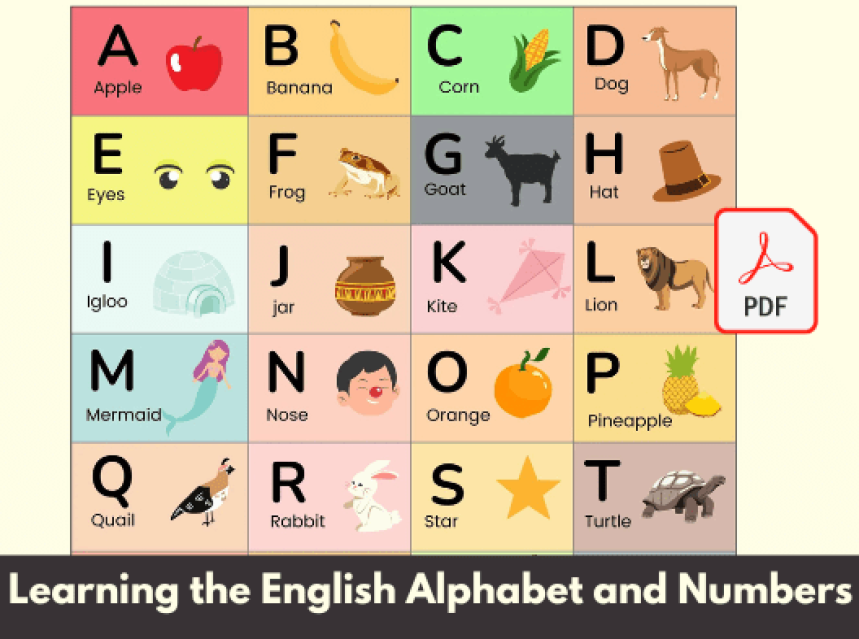
Learning the English alphabet and numbers gives beginners some of the building blocks they need for everyday English. You use letters when spelling your name, giving an email address, or looking up a word. You use numbers when talking about your age, prices, phone numbers, dates, addresses, and time.
In this beginner-friendly guide, you’ll learn:
- all 26 letters of the English alphabet
- uppercase and lowercase letters
- an easy example word for each letter
- English numbers from 1 to 20
- how to form larger numbers
- common number spelling mistakes
You can also download our free printable English alphabet and numbers PDF charts for classroom or home practice.
English Alphabet A–Z
The English alphabet has 26 letters. Each letter has an uppercase (capital) form and a lowercase (small) form.
For example:
A – a
B – b
C – c
An important point for English learners is that a letter and a sound are not the same thing. A letter may represent different sounds in different words.
For example, the letter A does not sound exactly the same in apple, cake, and about.
For beginners, start by learning to recognize, name, and write the 26 letters. You can study English sounds and phonics separately as your English develops.


English Alphabet with Example Words
| Capital | Lowercase | Example Word |
|---|---|---|
| A | a | Apple |
| B | b | Book |
| C | c | Cat |
| D | d | Dog |
| E | e | Egg |
| F | f | Fish |
| G | g | Game |
| H | h | House |
| I | i | Ice |
| J | j | Juice |
| K | k | Kite |
| L | l | Lion |
| M | m | Moon |
| N | n | Name |
| O | o | Orange |
| P | p | Pen |
| Q | q | Queen |
| R | r | Rain |
| S | s | Sun |
| T | t | Tree |
| U | u | Umbrella |
| V | v | Van |
| W | w | Water |
| X | x | Box |
| Y | y | Yellow |
| Z | z | Zoo |
Why Does X Use “Box”?
You may notice that our example for X is box rather than xylophone.
For beginners, box is a useful example because it demonstrates the common /ks/ sound represented by x. Words beginning with X are relatively uncommon in everyday English, and words such as xylophone begin with a sound more like Z.
Uppercase and Lowercase Letters
English uses both uppercase and lowercase letters.
Uppercase letters are also called capital letters.
Uppercase: A B C D E
Lowercase: a b c d e
We normally use a capital letter:
- at the beginning of a sentence: My name is Alex.
- for names: Sarah
- for countries and nationalities: Canada, English
- for days and months: Monday, January
- for the pronoun I: My brother and I are students.
How to Practise the English Alphabet
Don’t only memorize A–Z. Practise using letters in situations you may actually experience in English.
Try spelling:
Your name:
“My name is Mia: M-I-A.”
Your surname:
“Brown: B-R-O-W-N.”
A short word:
“Book: B-O-O-K.”
You can also practise spelling city names, usernames, email addresses, and other familiar words.
This helps turn alphabet practice into real communication practice.
Numbers in English: 1–20
Numbers appear everywhere in everyday English: prices, ages, dates, addresses, phone numbers, time, measurements, and quantities.
Start by learning the numbers from 1 to 20.

| Number | English |
|---|---|
| 1 | one |
| 2 | two |
| 3 | three |
| 4 | four |
| 5 | five |
| 6 | six |
| 7 | seven |
| 8 | eight |
| 9 | nine |
| 10 | ten |
| 11 | eleven |
| 12 | twelve |
| 13 | thirteen |
| 14 | fourteen |
| 15 | fifteen |
| 16 | sixteen |
| 17 | seventeen |
| 18 | eighteen |
| 19 | nineteen |
| 20 | twenty |
Numbers from 20 to 100
Once you know 1–20, larger numbers become much easier.
Learn these tens:
| Number | English |
|---|---|
| 20 | twenty |
| 30 | thirty |
| 40 | forty |
| 50 | fifty |
| 60 | sixty |
| 70 | seventy |
| 80 | eighty |
| 90 | ninety |
| 100 | one hundred |
To make many numbers between 21 and 99, combine the tens and ones:
21 → twenty-one
32 → thirty-two
47 → forty-seven
58 → fifty-eight
99 → ninety-nine
When these numbers are written as words, a hyphen is normally used between the tens and ones.
Common Number Spelling Mistakes
Some English number words don’t have the spelling learners expect.
40 = forty, not fourty
50 = fifty, not fivety
80 = eighty, not eightty
12 = twelve, not twelwe
It is also useful to pay attention to pairs such as:
13 – thirteen / 30 – thirty
14 – fourteen / 40 – forty
15 – fifteen / 50 – fifty
16 – sixteen / 60 – sixty
These pairs look and sound similar, so practise them in context rather than learning them only as a list.
Using Numbers in Everyday English
Knowing a number means more than recognizing it on a chart. Try using numbers in simple sentences.
Age: I am 18 years old.
Price: It costs $25.
Quantity: I have three books.
Time: The class starts at 9:00.
Date: My birthday is on May 12.
Address: I live at 42 King Street.
Phone numbers are usually spoken digit by digit rather than as one large number.
For example:
205 as an ordinary number → two hundred and five (common in British English) / two hundred five (common in American English)
But inside a phone number, 205 would normally be read as individual digits:
two – zero – five
Quick Alphabet and Numbers Practice
Try these without looking at the charts.
1. What letter comes after G? 1. H
2. What letter comes before M?
3. Write the lowercase form of R.
4. Spell your first name in English.
5. Write 14 in words.
6. Write 30 in words.
7. Write “forty-two” as a number.
8. Which spelling is correct: fourty or forty?
Show answers
2. L
3. r
4. Your own answer
5. fourteen
6. thirty
7. 42
8. forty
Download Free English Alphabet and Numbers PDFs
Use these printable resources for home study, homeschooling, tutoring, or classroom practice.
Download A–Z English Alphabet and Numbers PDF
Download A–Z Alphabet with Words PDF
Download Simple English Alphabet Chart PDF
Download Printable Numbers in English Chart PDF
FAQ: English Alphabet and Numbers
How many letters are in the English alphabet?
There are 26 letters in the English alphabet, from A to Z.
What are the vowels in English?
The five conventional vowel letters are A, E, I, O, and U. The letter Y can also represent vowel sounds in words such as my and happy.
Should beginners learn uppercase or lowercase letters first?
It is useful to recognize both. Lowercase letters appear very frequently in normal English text, while uppercase letters are important at the beginning of sentences and in names and other proper nouns.
Why can one English letter have different sounds?
English spelling and pronunciation do not have a simple one-letter-to-one-sound relationship. For example, the letter A is pronounced differently in words such as cat, cake, and about. Beginners should first learn to recognize letters and common words, then gradually develop their knowledge of English sounds and spelling patterns.
How can I practise English letters and numbers?
Use them in real situations. Spell your name, write a friend’s name, read prices, say your age, count objects around you, read house numbers, and practise writing dates and times.
Printable worksheets and alphabet charts can also help with regular review.
Final Tip for Beginners
Don’t worry about learning everything on this page in one day.
Start with A–Z and numbers 1–10. Then move to 11–20 and the tens up to 100.
Most importantly, use what you learn. Spell your name, count objects around you, read prices, and notice letters and numbers when you encounter English during the day.
A few minutes of real practice each day is more useful than simply memorizing a chart.



The examples for the letters are good, but they differ from your pictures for the alphabet. Also — ‘Eyes’ is a terrible word to have on your alphabet chart because it is teaching people that the sound for the letter E is a long I sound, as in Ice Cream. Also, Orange can be problematic because some people pronounce Orange with a short O sound, as in Octopus, but some people pronounce it as an Or sound as in Orchestra.
Thanks. Very useful alphabet PDF.