From Grammar Rules to Real-Time Judgments: What English Learners Teach Us About Navigating Dynamic Digital Environments
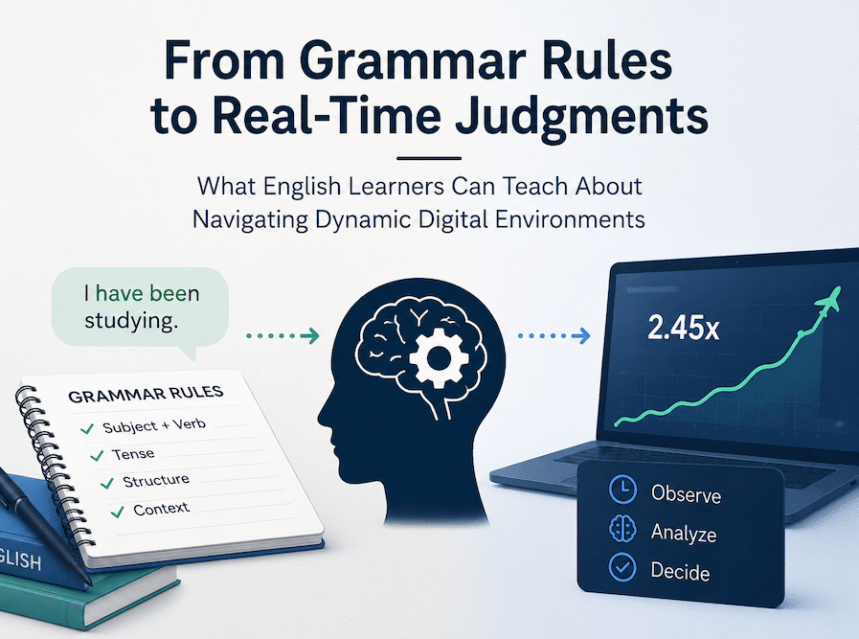
Language learning, particularly at an intermediate or advanced level, forces individuals to move beyond intuition and into structured reasoning. A learner cannot rely solely on what “sounds right” when dealing with English tenses such as present perfect continuous or past perfect, because these constructs follow strict rules that often contradict instinctive patterns from a native language. Over time, this process trains the brain to separate perception from correctness, replacing guesswork with frameworks.
This distinction becomes unexpectedly relevant in digital environments where outcomes unfold in real time. Many systems appear simple on the surface—clean interface, intuitive flow, minimal friction—but underneath they operate on rules that are not immediately visible. Users who rely on instinct or visual cues often misinterpret what is happening, just as beginner language learners misapply grammar based on familiarity rather than structure.
Understanding how language learners overcome this gap provides a surprisingly effective blueprint for interacting with fast, dynamic systems.
Why Rule-Based Thinking Outperforms Intuition in Dynamic Systems

Grammar as a Model for Structured Interpretation
When learning English, one of the first major obstacles is accepting that intuition is unreliable. A sentence like “I have been working here since 2018” cannot be replaced with “I am working here since 2018”, even though the second version may feel acceptable to a non-native speaker. The correct form depends on tense rules, time markers, and context—not on what seems natural.
This same principle applies to systems where outcomes evolve continuously. Interfaces may present smooth progressions or visually appealing sequences, but these elements do not define the underlying logic. Just as grammar rules determine sentence correctness regardless of intuition, system mechanics determine outcomes regardless of how they appear.
Interpreting Interface Signals Correctly
When interacting with environments similar to those accessed through the aviator app, users are presented with a clear visual progression—a multiplier increasing over time. At first glance, this resembles a structured pattern, similar to how language learners recognize sentence patterns.
However, the similarity is superficial. In language, patterns are governed by consistent rules. In probabilistic systems, patterns may appear but are not reliable indicators of future behavior. The interface is designed to communicate the current state clearly, not to signal what will happen next.
This is where trained learners have an advantage. They are accustomed to separating form (what they see) from function (what actually determines correctness). Instead of assuming that a rising curve implies continuation, they treat it as a representation of the present moment, much like a verb tense reflects a specific timeframe without predicting what follows.
Common Cognitive Errors Mirrored in Language Learning
- Beginners rely on familiar patterns, even when rules differ.
- Users assume continuity, expecting sequences to follow visible trends.
- Both groups overestimate the reliability of surface-level cues.
In language learning, these errors are corrected through repetition and rule reinforcement. In digital systems, however, users rarely receive structured feedback, which makes the errors persist longer.
Why Visual Clarity Increases Misinterpretation
A well-designed interface reduces friction, but it also increases confidence. When something looks simple, users assume it is easy to interpret. This is similar to reading a grammatically complex sentence written in simple vocabulary; it feels accessible, but subtle rules still apply.
As a result, clarity can create overconfidence. Users begin to trust their perception rather than questioning it, which leads to decisions based on appearance rather than logic.
Applying Language Learning Strategies to Real-Time Environments
Building Internal “Grammar” for System Interaction
Language learners eventually develop an internal model of grammar rules that guides their decisions automatically. A similar approach can be applied to digital systems by defining a personal set of interaction rules.
These rules should not depend on visual cues but on predefined logic. For example, instead of reacting to how far a sequence has progressed, decisions should be based on fixed criteria established beforehand. This removes ambiguity and reduces emotional influence.
Practical Techniques for Reducing Intuitive Errors
One of the most effective strategies borrowed from language learning is deliberate practice under constraints. In language, this might involve writing sentences using only a specific tense to reinforce understanding. In system interaction, it translates into limiting actions to predefined conditions.
Another technique is error tracking. Language learners improve by identifying recurring mistakes, such as misuse of articles or verb forms. Similarly, users can benefit from analyzing past decisions to detect patterns of misinterpretation, particularly those driven by visual bias.
A Structured Checklist for Disciplined Interaction
To translate these ideas into action, it is useful to adopt a simple checklist:
- Define rules before interaction (e.g., thresholds and limits).
- Separate observation from action (watch without reacting immediately).
- Avoid mid-process adjustments based on visual progression.
- Review decisions afterward to identify systematic errors.
This approach mirrors how learners move from trial-and-error to rule-based accuracy.
Non-Obvious Insight: Slowing Down Perception
One of the least discussed but most effective techniques in language learning is slowing down processing speed. Beginners often try to understand sentences too quickly, leading to errors. By consciously slowing down, they allow time for rules to apply.
In dynamic systems, slowing down perception—rather than action—can produce similar benefits. Instead of reacting instantly to visual changes, users pause to evaluate whether the change has any logical significance. This small delay often prevents impulsive decisions.
Turning Structured Thinking into a Long-Term Advantage
Over time, structured thinking becomes intuitive. Language learners eventually stop consciously applying rules, yet their accuracy improves. The same transition can occur in digital environments: disciplined interaction gradually replaces reactive behavior, leading to more consistent outcomes.
The key is repetition under controlled conditions. Without consistency, even well-defined strategies lose effectiveness.
Conclusion
The connection between language learning and real-time system interaction may not be immediately obvious, yet both require a shift from intuition to structured reasoning. In language, this shift is enforced by grammar rules that override instinct. In dynamic digital environments, the absence of explicit rules makes the transition more difficult, but no less necessary.
By adopting techniques from language learning—such as rule-based frameworks, deliberate practice, and error analysis—users can reduce the influence of visual bias and improve decision quality. The goal is not to eliminate intuition entirely, but to ensure that it operates within a structured context rather than driving decisions on its own.
Ultimately, the most effective approach combines awareness and discipline. Just as fluent speakers rely on internalized grammar rather than guesswork, successful interaction in fast systems depends on consistent logic rather than perception.