How Online K-12 Tutoring Can Support Student Success
A classroom tends to move at one pace, and that pace rarely fits every student. One kid falls behind the moment fractions show up. Another struggles quietly with reading comprehension for years before anyone notices. A third is ready to move faster than the curriculum allows but has nowhere to put that extra energy. Teachers do what they can with thirty students and one class period, but some gaps require individual attention in order to close. Online tutoring for kids has become a practical way to add that attention outside school hours, built around the student rather than the classroom schedule.
Because sessions happen from home and can be scheduled around a family’s own routine, online tutoring has grown into something bigger than homework help. Many programs now guide students as they improve their writing skills, strengthen reading and math, and build study habits that carry across every class. Below are the main ways online K-12 tutoring supports student success, from personalized instruction through test preparation and communication with parents.
What Is Online K-12 Tutoring?
Online tutoring connects elementary through high school students with an instructor via video, chat, or a shared virtual workspace instead of an in-person meeting. Most sessions run through a digital screen that the tutor and student can both see, so they’re working through the same problem together in real time.
Formats vary by provider. Some offer one-on-one sessions shaped entirely around a single student’s needs. Small-group classes bring together a handful of students working at a similar level. Live virtual classes follow a set weekly schedule, whereas on-demand resources let a student get help the moment they get stuck, even at ten p.m. the night before a test. None of these formats aim to take over for the classroom teacher; rather, each one is meant to reinforce what’s already being taught in school and fill in whatever the school day didn’t have time to cover.
Cost and pacing also differ quite a bit between providers. A family might pay per session, buy a block of hours, or subscribe monthly for unlimited access to on-demand help. Some schools and districts even fund tutoring directly through federal relief or student-support grants, making the option more accessible for families who couldn’t otherwise afford it.

Personalized Learning for Different Student Needs
Managing twenty or thirty students leaves a teacher little room to slow down for one student or speed up for another. A tutor, often working with just one student at a time, can shape a lesson around where that student actually stands rather than where a syllabus assumes they should be by now.
Sometimes that means repeating a tricky math concept a few different ways until one of them clicks. Sometimes it means handing an already-ahead student more challenging material instead of watching them coast. Tutors also tend to catch learning gaps early, before a small misunderstanding calcifies into a pattern of struggling with an entire subject.
Strengthening Core Academic Skills
Skills in math, reading, writing, and science develop through repetition, and tutoring gives students a regular space for that repetition with someone who pays attention to their mistakes. A student who keeps mixing up multiplication and division won’t always catch that pattern on their own, but a tutor will.
That kind of targeted practice builds skills progressively rather than leaving students to memorize facts the night before a quiz. A student working through algebra with a tutor each week is laying groundwork for geometry down the line, not just surviving Friday’s test.
Building Student Confidence and Motivation
Confidence tends to track pretty closely with understanding. A student who feels behind in class often stops raising their hand, which only makes the gap harder to close. One-on-one or small-group tutoring usually feels lower-stakes than a full classroom, so students end up more willing to ask the question they’d been too embarrassed to pose at school.
Small, specific goals do more for motivation than a single overall grade ever could. Getting long division right consistently, week after week, might sound minor, but celebrating that kind of incremental win keeps a student coming back and trying.
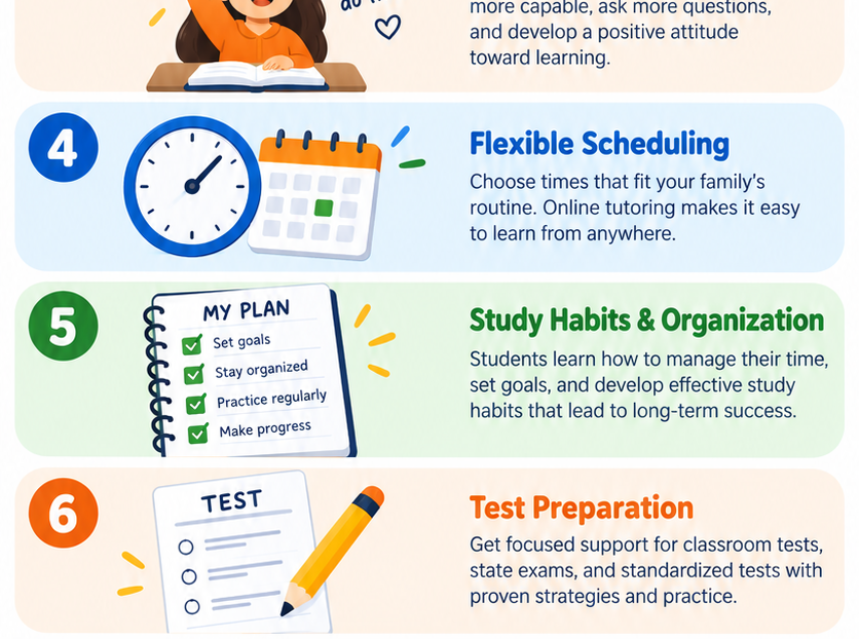
Providing Flexible Academic Support
Between school, sports, music lessons, and everything else on a family’s calendar, free time is scarce. Online tutoring fits into whatever’s left of it. A session can happen after dinner, on a Sunday afternoon, or squeezed between two other activities, all without needing to be driven to another location. That flexibility matters even more for families without a tutoring center nearby, or whose local options don’t cover a particular subject or grade level. Logging in from a kitchen table removes a lot of the logistics that used to keep families from getting consistent help.
Supporting Students Beyond Homework Help
The strongest tutoring programs do more than get an assignment finished by bedtime. Good tutors also build the habits that make a student sharper in every class: time management, organization, effective note-taking, and the ability to study alone for a test without needing someone standing over their shoulder.
None of those skills develop without help. The U.S. Department of Education has found that well-designed, well-implemented tutoring programs can meaningfully speed up learning when sessions stay consistent and target a student’s real needs, which is exactly what structured study-skills coaching is built to do. A student who learns to build better study habits through tutoring carries that skill into every subject, well past whichever one they started tutoring for.
Helping Students Prepare for Tests and Academic Milestones
A unit test, a final exam, or a standardized assessment: each calls for a different kind of preparation than a general classroom review provides. A tutor who’s worked with a student for months usually knows exactly which topics still need more practice and prioritizes them rather than reviewing everything with equal weight.
Preparation might include practice questions and timed review sessions. It can also mean coaching on pacing through a section or eliminating obviously wrong answers before guessing. A U.S. Department of Education issue brief on academic tutoring found that tutoring is linked to improved test scores and grades when it stays focused and sustained over time, reminding us that the real goal is understanding the material, not memorizing it the night before.
Improving Communication Between Students, Parents, and Educators
A tutor meeting with the same student week after week often notices patterns a busy parent or classroom teacher might miss: a subject the student consistently trips over, or a skill that’s clearly stronger than anyone expected. That insight only helps if someone actually hears about it.
Plenty of online tutoring platforms now include progress reports or short session summaries so parents get a clearer picture of where their child stands. Parents can use that feedback to decide what to reinforce at home, and tutoring tends to work best when it complements what the classroom teacher is already doing rather than operating in a separate lane.
Using Technology to Create an Engaging Learning Experience
Tools that simply didn’t exist for earlier generations of after-school help now shape how online tutoring runs. A virtual whiteboard lets a tutor work through a geometry proof step by step, right alongside the student. Screen sharing lets a tutor walk through an assignment on the student’s screen instead of describing it over the phone.
Handled well, this technology makes a lesson genuinely interactive rather than another static worksheet. Handled poorly, it turns into a distraction of its own. Technology should support the learning, not compete with it, and a whiteboard used to break down a real problem does far more good than an animation with no instructional point. Some platforms also record sessions so a student can rewatch a tricky explanation later, turning a single hour of tutoring into something a student can return to as often as needed while studying independently.
How Parents Can Choose the Right Online K-12 Tutoring Program
Not every program fits every student, so it’s worth thinking through a few things before signing up. Consider:
- The student’s grade level, current academic needs, and preferred way of learning
- The family’s schedule and how much flexibility it actually requires
- Whether the goal is catching up, staying on pace, or reaching ahead of their grade level
From there, check the tutors’ qualifications and subject expertise. Look for genuinely personalized instruction and a clear way to track progress over time. Class size matters too, along with the technology used, how the program communicates with parents, and how easily sessions fit into a busy week. It’s also important to confirm that the program’s approach matches the student’s age and what they’re currently learning in school.
Tips for Helping Students Get the Most From Online Tutoring
These habits tend to make the biggest difference in what a student actually gets out of tutoring:
- Keep a consistent schedule rather than booking sessions whenever it’s convenient
- Set up a distraction-free space away from phones and siblings
- Encourage real participation: asking questions, working through problems out loud
- Set specific, realistic goals for each stretch of sessions
- Track progress over weeks and months instead of judging by a single session
- Push the student to apply what they’ve learned on their own, so it actually sticks
Conclusion
Online K-12 tutoring works alongside the classroom rather than around it, closing gaps that one teacher managing a full room can’t always reach alone. Done well, it delivers personalized instruction and flexible scheduling, along with the kind of consistent, targeted support that builds real skill over time. It also builds confidence and study habits students carry well past whatever subject first brought them to a tutor. The programs that hold up best are the ones shaped around one student’s actual needs, tracked and adjusted as those needs change, instead of being treated as a fix that works the same way for everybody.