How to Practice English Speaking: 12 Tips for Real Conversations
While learning English grammar and increasing your vocabulary are important steps to being fluent, they are not the only steps. Many students are able to read and listen to English quite well but are unable to speak English.
The answer is easy – speaking gets better when you practice it.
There is no better way to learn to think in English, speak fast, find words, listen carefully and get used to making mistakes than real conversations. The more you can use English in real conversations, the more natural your English will sound.
These are some practical tips for enhancing your English speaking abilities in a real conversation.

Speak English Every Day!
It is not necessary to practice for hours each day. The important thing is to be consistent, not necessarily the length of each session.
Try to have at least one short conversation in English every day. Discuss your work, studies, hobbies, news, travel plans or anything else that interests you.
Just 10-15 minutes of speaking a day can make you feel more comfortable in expressing yourself.
It’s not perfection of speech. The aim is to be comfortable in spontaneous use of English.
Make a partner to practice English with.
Regular practice with someone is one of the most difficult things for English learners.
You can have opportunities to talk to friends, classmates, colleagues, language exchange partners, and online communities.
Online conversation sites are also a great way to connect with people from other countries and talk with them in English. You can find people to practice English with on such random stranger chat platforms.
The upside of talking to strangers is that you never know what they’re going to say. This brings the practice more in line with real-life communication.
Don’t translate each sentence in your mind.
Many students initially think of a sentence in their native language and then translate it into English.
This can slow down and frustrate your speech.
Rather, attempt to develop the habit of thinking directly in English. Start with simple concepts:
I have to complete this today.
I feel very tired.
What is your favorite meal of the day?
I have to call my friend.
The more comfortable you become, the more you will be able to think in English.
This is particularly useful when listening and responding to real conversations, where you will need to listen and respond without over translating.
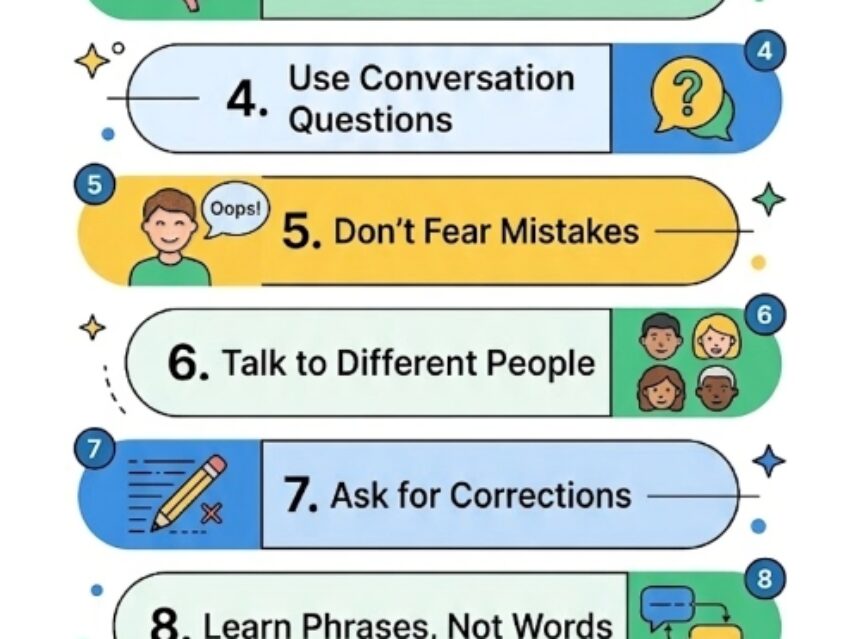
Use Conversation Questions
If you can’t think of anything to say, make a list of questions to ask.
For example:
What do you usually do on the weekend?
What is your favorite place that you have been?
What type of music do you like?
What is your goal for learning this year?
What is one thing that you could talk about for a long, long time?
Would you like to live in a large city or small town?
Questions such as these help to facilitate conversation and get you to communicate your thoughts instead of just one-word responses.
Begin with simple questions and build up to more difficult questions that have longer answers and more advanced vocabulary.
Be not afraid of making mistakes
One of the most difficult things to overcome when it comes to speaking English is fear of getting it wrong.
It will not be a perfect fit.There will be errors. That is normal.
You may never be able to get enough practice if you wait until your grammar, pronunciation and vocabulary are perfect before you speak.
Rather, see errors as learning opportunities.
When a word is mispronounced and corrected, record the correct pronunciation and say it again in a different situation.
Errors are not the same as lack of fluency. It is the ability to keep talking even if you don’t know the exact word or sentence.
Interact with others in play.
It’s good to speak with the same person each day, but it’s different when you speak with different people.
Individuals have varying accents, word choice, pace of speech, personality and communication style.
Talking to a variety of people on a regular basis helps you to learn English in unfamiliar contexts.
This is particularly helpful for students who want to use English in the future, on their travels, in another country, at work or with people from other countries.
Ask Someone to Correct Your English
If you are working with another person, tell him or her that you are learning English and that you would like him or her to correct you from time to time.
You don’t have to have all sentences corrected. Having too many interruptions can make conversation awkward.
Instead, ask them to name some of the common or common recurring mistakes.
For example, if you are continuing to use the same preposition, pronunciation or verb tense, it may be more helpful to correct that pattern than to correct every little mistake.
After the discussion, jot down some notes of corrections and review them.
Learn Phrases, Not Just Individual Words
Thousands of individual English words don’t guarantee fluency in English.
Common combinations of words and expressions are used by native speakers.
For example, don’t memorize the word opinion, memorize phrases such as:
“In my opinion…”
“I completely agree.”
I don’t know about that.
“The way I see it…”
“Right you are.”
Knowing a few useful phrases provides you with instant sentence components to use in conversations.
When you hear a helpful saying during a conversation, write it down and incorporate it into your own conversation.
Discuss things you really like to do
It is easier to practise speaking when you are talking about something you are interested in.
If you enjoy football, discuss your favourite team. If you enjoy technology, discuss a new device or application. If you love movies, tell about your favourite movie and why you like it.
If you’re interested in the topic, you’ll have something to say. This provides you with more chances to practise vocabulary, sentence structures, explanations and opinions.
Vocabulary is also included that is relevant to you personally, making it easier to remember.
Speak for Longer: Challenge Yourself!
If you’re comfortable with short conversations, slowly start talking for longer periods.
Use one or two minutes on a familiar topic as a starting point. Then try 5 minutes, then 10 or 15 minutes.
To choose a topic and describe:
What it is
What is your motivation for studying it?What’s your reason for learning it?
Your personal experience with it.
Your thoughts on it
What you think might happen in the future
This means that you will have to use a variety of vocabulary and sentence structures.
Pay attention to others’ speech
Talking is just half the communication.
Good listening skills are essential to good conversations.
Listen to others’ pronunciation, sentence structure, expressions and answers to questions.
If you hear a word you don’t know, ask for its definition. If you notice something creative that you can say, record it and try to use it yourself.
Real conversations make you familiar with English as it is actually used, not just the carefully constructed English that you find in books.
Develop a Regular Speaking Practice Schedule
The best speaking routine is one that you can follow!
Establish a basic weekly schedule of multiple modes of speaking:
Have short, daily discussions.
Communicate with language partner multiple times a week.
Discuss a new topic each week.
Maintain a list of new expressions.
Review common mistakes.
Record yourself and listen to your recording from time to time.
There’s no need to have a complex study plan. It is important to provide sufficient opportunities for the use of English.
Final Thoughts
Becoming proficient in English isn’t just about learning words and grammar. It is also important to get used to the language. Those skills are the building blocks; real conversations teach you how to use English naturally.
Speak to various people, speak on various subjects, learn from what you do wrong, and then slowly work up to longer periods of speaking.
Most importantly, don’t wait until you are able to speak perfect English before you do so. The best way to improve your speaking is to practice speaking.
The more you speak English, the more confident and natural you can be.