Learn English with Instagram Reels: A Simple Shadowing Routine
A student of mine once told me she learned more English on the bus than in my classroom. I laughed. Then I asked her how.
Her answer was Instagram Reels. Short clips from teachers and native speakers, played again and again on a 40-minute ride, mouthing the words under her breath. She had stumbled onto shadowing, one of the oldest pronunciation methods there is, and she was doing it with her phone.
Since then I have built the same habit into my own lessons. This article explains the routine, how to keep a small library of lesson reels on your phone, and which ways of saving them work best for study. I also compare the options, because they are not equal.
Why short videos work for listening practice
Textbook audio is slow and careful. Real speech is not.
On Reels you hear people talk the way they actually talk: linked sounds, dropped letters, quick questions, jokes. A good teacher reel takes one point, say the difference between “live” and “leave”, and repeats it in 30 to 60 seconds. That is the perfect size for a learner. You can play it ten times in five minutes without getting bored, and each time you catch something new.
The short length also lowers the pressure. Nobody can sit through a two-hour film with full attention in a second language. One minute? Easy.
The shadowing routine I give my students
Shadowing means you listen to a speaker and repeat what they say at almost the same time, like a shadow following a person. It trains your ear, your mouth and your rhythm together. Here is the version I use with intermediate learners.
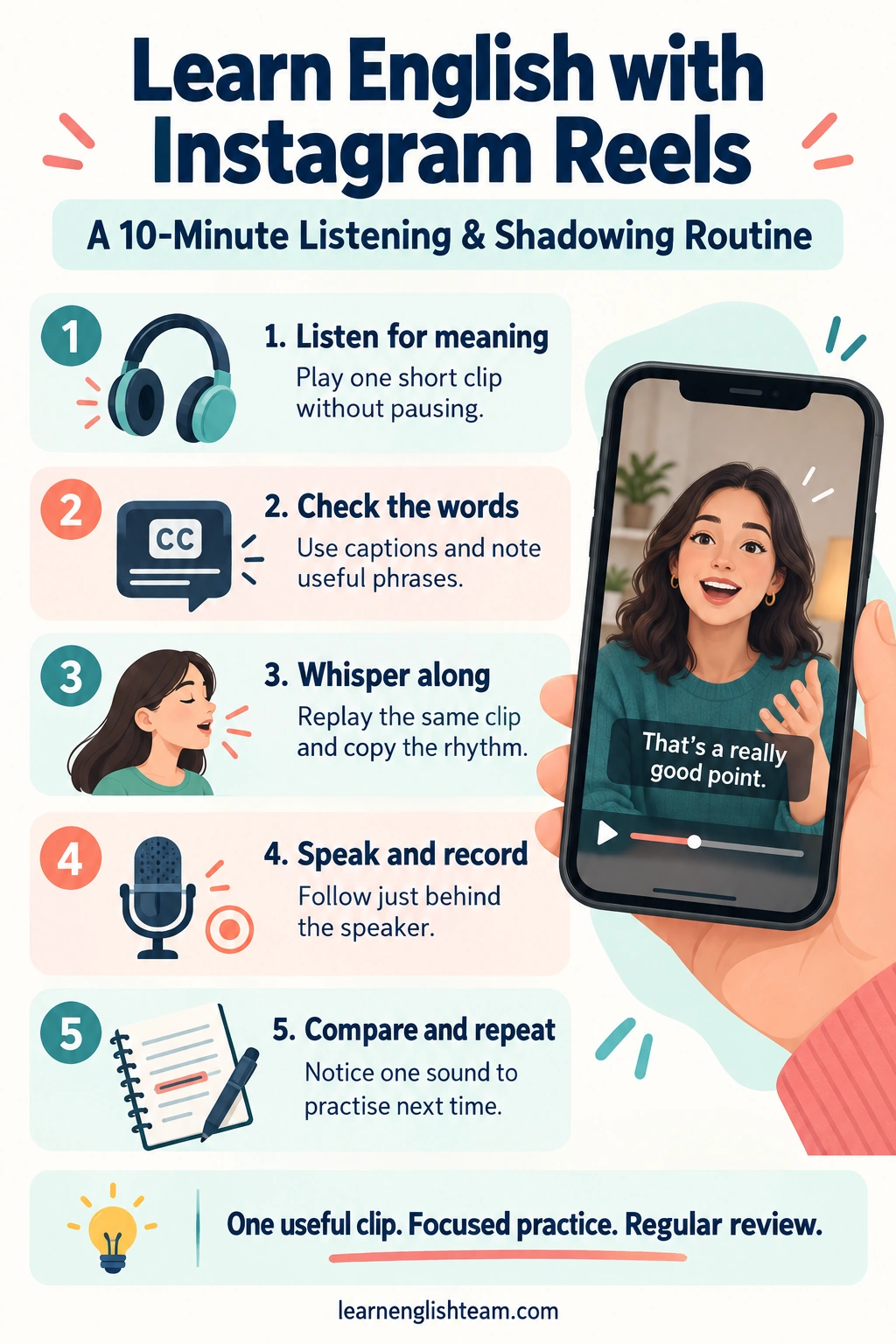
- Listen once with no pause. Just get the meaning.
- Listen again with subtitles or a transcript if the creator added one. Write down any word you did not catch.
- Play it a third time and whisper along. Do not worry about mistakes.
- Now speak out loud, a half second behind the speaker. Copy the stress, the pauses, even the facial expression.
- Record yourself once at the end and compare. This part feels awkward. Do it anyway.
That whole cycle takes about ten minutes for one reel.
Do it five days a week and your ear starts to change. How fast depends on the learner, and nobody can promise a date. The key is repetition of the same clip, not watching hundreds of new ones. Scrolling feels like study. It usually is not.
The problem: Reels disappear when you need them
Here is where most learners get stuck. You find a great pronunciation reel on Monday. By Thursday it is lost somewhere in your feed. Or you are on a train with no signal, or your mobile data is almost finished for the month, and the video will not load.
Shadowing needs the same clip, many times, with no buffering. So you need some way to keep the reels you study.
There are several ways to do that. Below is how I would rank them for language learning, with a short “best for” label on each.
Ways to save lesson reels, ranked for study
1. Sssinstagram: best for an offline study library
For a real offline collection, my first choice is Sssinstagram, a web tool where you paste the link of a public reel and download it as an MP4 file. It runs in the browser on a phone or a computer, so there is no app to install, and you do not need to log in or create an account.
Why does that matter for study? Because an MP4 file is yours to control. You can open it in any video player, slow it down, loop one sentence, or put it in a folder called “Pronunciation: vowels”. It plays with no internet at all. The site says the video is saved in the resolution Instagram stores and without an added watermark, which is helpful when you want to watch a teacher’s mouth closely.
The limits are simple. It works only with public content. Private accounts stay private.
The little bookmark icon under every reel puts it in your Saved collections. It is free, built in and fast, and you can sort clips into named collections. I use it every day for things I might watch later.
But it is a bookmark, not a copy. You still need a connection to play the clip, and if the creator deletes the reel, it is gone from your collection too.
3. Screen recording: best when nothing else is available
Most phones can record the screen. It works on almost anything you can see. The downsides: the file picks up notifications and on-screen buttons, the quality often drops, and you have to sit and watch the whole clip in real time to record it. Fine for one clip. Tiring for twenty.
On some public reels, Instagram shows its own download choice in the share menu. Whether you see it depends on the account and the creator’s settings, so it is not something you can plan around. Use it when it appears.
Quick comparison
| Method | Works offline | Needs an account | Install needed | Good for a study library |
| Sssinstagram | Yes (MP4 file) | No | No, browser | Yes |
| Instagram save button | No | Yes | Instagram app | Partly |
| Screen recording | Yes | Depends on the clip | Built into most phones | Partly |
| Instagram share menu download | Yes, if it appears | Yes | Instagram app | Only when available |
How to build a small personal library
Keep it small. Really small.
I tell students to aim for 15 to 20 reels at most, grouped by topic. A library you actually use beats a folder of 300 clips you never open. Some groups that work well:
- Sounds that are hard for you (for many learners in India, that might be “v” and “w”, or the “th” sounds)
- Everyday phrases: greetings, small talk, phone calls
- Phrasal verbs explained with examples
- Interview and office English
- Stories or jokes told slowly by native speakers
Rename each file with the main point, for example “th-sound-think-vs-sink.mp4”. Then when you have ten minutes on a commute, you open the folder and you know exactly what to practise. Once a clip feels easy, delete it and add a harder one.
A notebook helps as well. Next to each file name, write the two or three sentences you shadowed and any new words. After a few weeks you have a personal phrasebook built from real speech.
Respect the creators
The teachers who make these reels put real time into them. Saving a clip for your own study is one thing. Posting it again on your account, or sharing it in a group as if it were yours, is something else.
My rule for students is plain: download for personal study, keep it on your device, and if you want to share or reuse a clip anywhere, ask the creator first and credit them. Better still, follow them, like their posts and leave a comment. That is how good free teachers keep making content.
Start this week
Pick one teacher whose accent you like. Save three of their reels. Shadow one each day for a week, record yourself on day one and day seven, and listen to both.
The difference is usually easy to hear.