
100 Common English Verbs and Synonyms List PDF
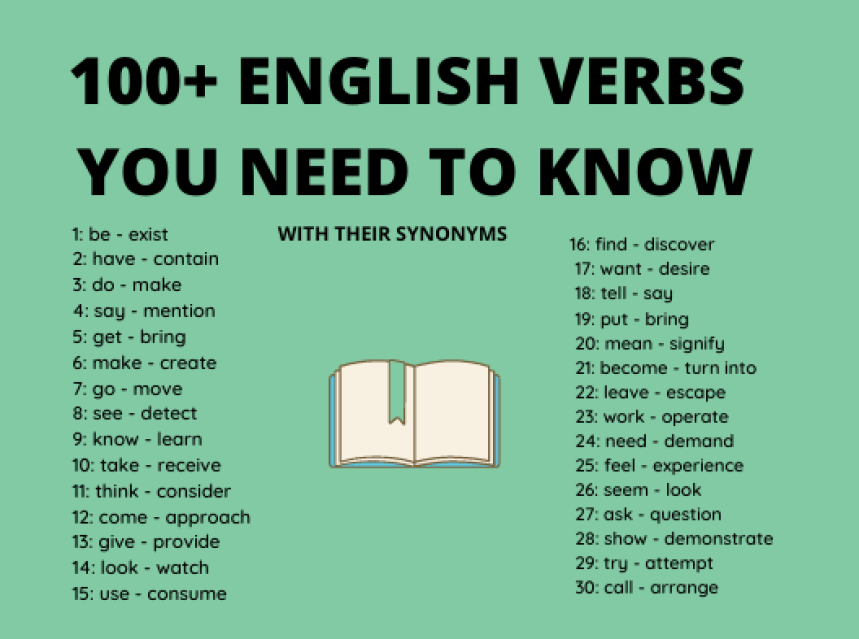
Learning the most common English verbs and their synonyms can help you speak and write more naturally. Verbs are essential because every complete English sentence needs a verb.
In this lesson, you will learn what verbs and synonyms are, see a useful list of common English verbs, and download a free PDF containing 500 English verbs and their synonyms.
You may also find our guide to the 100 most commonly used English verbs helpful.
What Is a Verb?
A verb is a word that describes an action, a state, or an occurrence.
| Verb type | Meaning | Examples |
|---|---|---|
| Action verb | Shows what a person or thing does | run, drink, play, sing, watch |
| State verb | Describes a feeling, opinion, possession, or condition | believe, know, own, prefer, understand |
| Occurrence verb | Describes something that happens or changes | happen, become, develop, grow, change |
Verb Examples in Sentences
- They play football every Saturday.
- I believe your story.
- The weather changed suddenly.
- She owns a small bookshop.
- The accident happened at night.
Important: Every complete English sentence normally needs a verb.
Incorrect: She very happy.
Correct: She is very happy.
What Is a Synonym?
A synonym is a word or phrase that has the same or nearly the same meaning as another word.
For example:
- buy and purchase
- start and begin
- help and assist
- choose and select
- answer and reply
Synonyms are useful because they help you avoid repetition and make your English vocabulary more varied.
Why Should You Learn Verb Synonyms?
Learning synonyms for common verbs can improve your English in several ways:
- It helps you avoid repeating the same words.
- It improves your speaking and writing vocabulary.
- It helps you understand books, articles, and conversations.
- It makes formal writing more accurate.
- It can help you perform better in IELTS, TOEFL, and other English exams.
For example, instead of using the verb say repeatedly, you can sometimes use explain, mention, state, reply, or announce. However, these words are not always interchangeable, so you should pay attention to context.
100 Common English Verbs and Their Synonyms
Below are some of the most commonly used English verbs with useful synonyms.
| Common verb | Synonyms |
|---|---|
| Ask | question, request, inquire |
| Answer | reply, respond |
| Begin | start, commence |
| Buy | purchase, acquire |
| Choose | select, pick |
| Close | shut, seal |
| Continue | carry on, proceed |
| Explain | clarify, describe |
| Find | discover, locate |
| Get | receive, obtain, acquire |
| Give | provide, offer |
| Help | assist, support, aid |
| Keep | retain, preserve |
| Leave | depart, exit |
| Look | watch, observe, glance |
| Make | create, produce |
| Need | require |
| Say | state, mention, express |
| Show | display, demonstrate, reveal |
| Think | believe, consider, suppose |

The full visual list includes more than 100 commonly used English verbs and their synonyms.
Be Careful: Synonyms Are Not Always Identical
Two synonyms may have similar meanings, but they are not always used in exactly the same way.
For example:
- I bought a new phone.
- I purchased a new phone.
Both sentences are correct, but purchase sounds more formal than buy.
Another example:
- She looked at the picture.
- She observed the picture carefully.
Observe usually suggests more careful attention than look at.
Learning tip: Do not only memorize synonym lists. Study each word in a complete sentence so that you understand its tone, grammar, and natural use.
Common Verb Synonyms in Sentences
| Common verb | More formal synonym | Example |
|---|---|---|
| help | assist | The teacher assisted the new students. |
| buy | purchase | We purchased the tickets online. |
| show | demonstrate | The instructor demonstrated the activity. |
| need | require | This job requires experience. |
| start | commence | The meeting will commence at 10 a.m. |
| tell | inform | Please inform us about any changes. |
| use | utilize | The system utilizes modern technology. |
| get | obtain | You must obtain permission first. |
500 English Verbs and Synonyms PDF
Download our comprehensive PDF containing 500 common English verbs and their synonyms. This printable resource is useful for vocabulary study, speaking practice, writing improvement, classroom lessons, and exam preparation.
The PDF is suitable for:
- Beginner and intermediate English learners
- ESL and EFL students
- English teachers and tutors
- IELTS and TOEFL learners
- Classroom vocabulary activities
- Independent study
How to Study English Verb Synonyms
- Learn a few verbs at a time. Study five to ten new verbs each day.
- Write example sentences. Create one sentence for each verb and synonym.
- Group words by meaning. For example, study verbs related to speaking, movement, thinking, or emotions.
- Notice formal and informal language. Compare words such as buy and purchase.
- Review regularly. Repetition helps move new vocabulary into your long-term memory.
- Use the words in conversation. Try replacing simple verbs with suitable synonyms when speaking.
Watch the Video Lesson
Watch the video below to review common English verbs and expand your vocabulary.
Frequently Asked Questions
What is a verb in English?
A verb is a word that expresses an action, state, or occurrence. Examples include run, believe, own, become, and happen.
What is a synonym?
A synonym is a word with the same or a similar meaning as another word. For example, begin and start are synonyms.
Why should English learners study verb synonyms?
Verb synonyms help learners avoid repetition, understand more texts, improve formal writing, and express ideas more accurately.
Are all synonyms interchangeable?
No. Synonyms can differ in formality, strength, grammar, and context. For example, purchase is more formal than buy, while observe often suggests more careful attention than look at.
How many verbs should I learn each day?
Learning five to ten verbs and their synonyms each day is a realistic goal. Review them regularly and use them in complete sentences.
Download the PDF, review the list regularly, and practise using each verb in your own sentences. Consistent practice will help you build a stronger and more flexible English vocabulary.


Thank u for teaching English and free pdf 🙏🏻
You are welcome 🙂
Thanks you so much 👍👍👍for this free of cost pdf .❤️ Thanks again
You are welcome! 🙂
i just discover this site, it’s really very helpful. Thank you so much
You are welcome! 🙂