
Modal Verbs in English: Rules, Examples – Free PDF
Modal Verbs in English
Modal verbs are different from normal English verbs. We use modal verbs to express ability, permission, possibility, obligation, advice, requests, and offers. They help us show attitude and meaning rather than action.
One important rule is that modal verbs never take “-s” in the third person singular.
She musts walk her home every day. ❌ (wrong)
She must walk her home every day. ✔️ (correct)

Modal Verbs + Bare Infinitive
After can, could, may, might, shall, should, will, would, must, have to, we always use a bare infinitive (the base form of the verb without to).
We do NOT use:
- a past verb form
- an -ing form
- to + verb (except with ought to)
I could to swim when I was nine. ❌ (wrong)
I could swim when I was nine. ✔️ (correct)
Active and Passive Infinitives
The infinitive after modal verbs can be active or passive, depending on the meaning.
- The robbers may be caught soon.
- Your money may be found soon.
- I think this radio can be repaired.
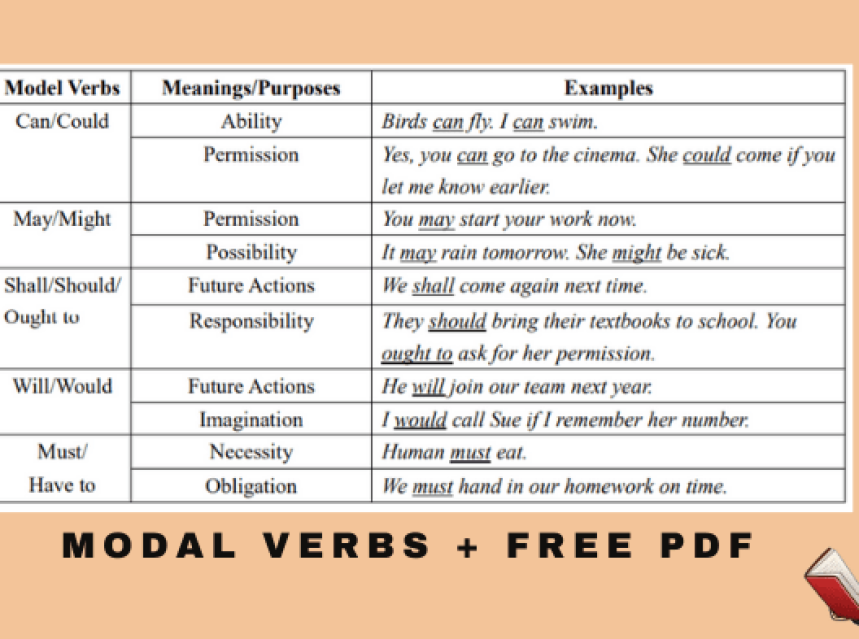
Modal Verbs List with Meanings and Examples
Can & Could
Ability:
- Birds can fly.
- I can swim.
Permission:
- Yes, you can go to the cinema.
- He could ride my car if he told me earlier.
May & Might
Permission:
- You may see your friends now.
Possibility:
- It may snow tomorrow.
- She might be very sick.
Shall, Should & Ought to
Future / Suggestions:
- We shall visit again next time.
Advice / Responsibility:
- They should bring their books to school.
- You ought to ask for your father’s permission.
Will & Would
Future actions:
- She will join our team next month.
Imagined or polite situations:
- I would call Mary if I remembered her number.
Must & Have to
Necessity:
- Humans must eat.
Obligation:
- You must hand in your homework on time.
- I have to help my mother tomorrow.

Using Modal Verbs for Requests, Offers, and Permission
Modal verbs are commonly used to make requests, offers, invitations, and ask for permission.
Can & Could (Requests)
- Can you give me some water?
- Could you wait for her for a while?
Can & Would (Offers / Invitations)
- Can I help you?
- Would you like a cup of tea?
Can / Could / May (Permission)
- Can I speak to Mohammad, please?
- Could I ride your bike?
- May I come in? (more formal and polite)
Modal Verbs PDF (Free Download)
You can download a free PDF with detailed explanations, examples, and exercises to practice modal verbs.
Modal Verbs List PDF – Download

Good
wow that is good notes it is important this topic.
Yes, that was really helpful.
Modal verbs list is such a great notes for me. Thanks.