
Prepositions of Time and Place: At, In, On & To (PDF)
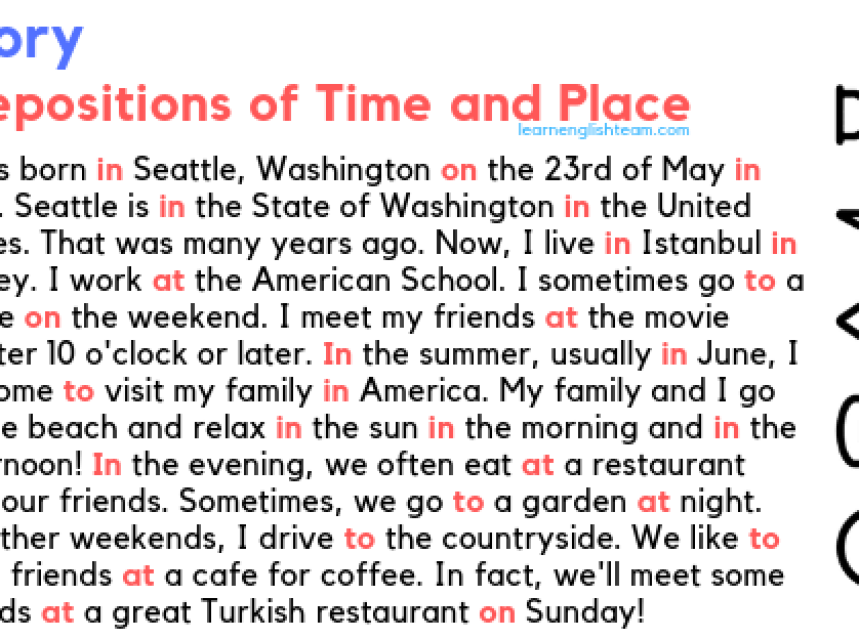
Prepositions of time and place help us explain when something happens, where a person or object is, and where someone is going. Four of the most common English prepositions are in, on, at, and to.
These words are short, but they can be confusing because their meanings change depending on the time expression, place, or verb used. In this lesson, you will learn the main rules, study clear examples, read a short story, complete practice exercises, and download a free printable worksheet.
Quick guide
- Use in for months, years, seasons, countries, cities, large areas, and enclosed spaces.
- Use on for days, dates, special days, and surfaces.
- Use at for exact times and specific points or locations.
- Use to for movement toward a destination.

Prepositions of Time and Place: Quick Reference
| Preposition | Main use | Examples |
|---|---|---|
| In | Months, years, seasons, countries, cities and enclosed spaces | in May, in 2026, in London, in the room |
| On | Days, dates, special days and surfaces | on Monday, on June 5th, on Eid al-Fitr, on the table |
| At | Exact times and specific points | at 9 o’clock, at school, at the station |
| To | Movement toward a destination | go to school, travel to Paris |
When to Use “In”
We use in for longer periods of time, large geographical areas, enclosed spaces, and places that we think of as being inside a larger area.
1. Months
- I was born in May.
- She starts school in September.
- John will fly to Istanbul in August.
2. Years, Decades and Centuries
- She was born in 2010.
- They moved here in 2024.
- Music changed greatly in the 1990s.
- Technology has developed rapidly in the 21st century.
3. Seasons
- I like swimming in summer.
- Flowers begin to grow in spring.
- It often snows in winter.
- The leaves change colour in autumn.
4. Countries, Cities and Towns
- He lives in Turkey.
- The company is located in Germany.
- She studied English in Thailand.
- He has an apartment in Paris.
- I was born in Seattle.
- She works in São Paulo.
5. Rooms, Buildings and Enclosed Spaces
- The students are in the classroom.
- She is waiting in the car.
- There is some milk in the fridge.
- The children are playing in the garden.
6. Parts of the Day
- I wake up early in the morning.
- He studies English in the afternoon.
- Elise sometimes plays tennis in the evening.
Important exception:
We say in the morning, in the afternoon, and in the evening, but we normally say at night.
7. Ramadan and Other Periods
For religious or cultural periods that continue for several days or weeks, English speakers often use during rather than in or at.
- Many Muslims fast during Ramadan.
- Families often spend more time together during Ramadan.
- People may travel more during the holiday season.
When to Use “At”
We use at for exact times and specific points or locations.
1. Exact Times
- Let’s meet at 9 o’clock.
- She has a meeting at 9:15.
- The lesson starts at noon.
- He usually goes to bed at midnight.
2. Specific Places or Points
- They met at school.
- Let’s meet at the library.
- She works at a shop.
- We waited at the bus stop.
- They arrived at the airport early.
We use at when we think of a place as a particular point or activity rather than as an enclosed space.
- She is at school. This means she is there as a student.
- She is in the school. This emphasizes that she is physically inside the building.
3. Holidays and Celebrations
We can use at when talking about a holiday or celebration as a general period.
- We visit our family at Christmas.
- Many families gather at Eid.
- People often visit relatives at New Year.
However, during is also natural and is often clearer for international learners.
- Families often gather during Eid.
- We usually visit relatives during the holiday period.
British and American English:
In British English, people commonly say at the weekend or at weekends.
In American English, people commonly say on the weekend or on weekends.
When to Use “On”
We use on for days, dates, named special days, and surfaces.
1. Days of the Week
- They will meet on Sunday.
- We have English class on Monday.
- She plays tennis on Fridays.
2. Dates
- She was born on June 5th.
- The course begins on September 12th.
- Our school closes on December 31st.
3. Special Days and Religious Holidays
Use on when referring to a particular named day.
- What do you do on New Year’s Day?
- We visit our grandparents on Christmas Day.
- Families often gather on Eid al-Fitr.
- Many people visit relatives on the first day of Eid al-Adha.
- The school is closed on Republic Day.
- They had a family meal on the final day of Ramadan.
Holiday rule:
Use at or during for a holiday period in general:
at Christmas, at Eid, during Ramadan, during Eid
Use on for a particular holiday day:
on Christmas Day, on Eid al-Fitr, on the first day of Eid al-Adha
4. Surfaces
- The keys are on the table.
- There is a picture on the wall.
- Your bag is on the chair.
- The book is on the shelf.
5. Days with Parts of the Day
- We have a meeting on Monday morning.
- She arrived on Friday evening.
- They played football on Saturday afternoon.
When to Use “To”
We use to with verbs that show movement toward a destination.
- She goes to school every day.
- He returned to the office.
- They are going to the restaurant.
- We travelled to Spain last summer.
- John walked to the station.
Important exception:
Do not normally use to before home when it follows a verb of movement.
Incorrect: She goes to home.
Correct: She goes home.
Correct: She returned to her home.
Arrive At, Arrive In and Go To
Do not normally use arrive to. Use arrive at for smaller or specific places and arrive in for cities, countries, and larger areas.
- We arrived at the airport at 7 a.m.
- She arrived at school early.
- They arrived in London yesterday.
- He arrived in Turkey in June.
- We went to the airport by taxi.

In, On, At and To: Common Differences
| Expression | Correct preposition | Example |
|---|---|---|
| Month | In | in September |
| Year | In | in 2026 |
| Season | In | in summer |
| Day | On | on Tuesday |
| Date | On | on December 31st |
| Named holiday day | On | on Eid al-Fitr |
| Exact time | At | at 10 o’clock |
| Specific point | At | at the airport |
| Country or city | In | in France, in Paris |
| Movement | To | go to the beach |
Common Mistakes with Prepositions
| Incorrect | Correct |
|---|---|
| in Monday | on Monday |
| at July | in July |
| in 8 o’clock | at 8 o’clock |
| on summer | in summer |
| in Christmas Day | on Christmas Day |
| at Eid al-Fitr | on Eid al-Fitr when referring to the particular day |
| at the first day of Eid | on the first day of Eid |
| in Ramadan | during Ramadan is often clearer and more natural |
| go to home | go home |
| arrive to the airport | arrive at the airport |
| arrive to London | arrive in London |
Example Story Using Prepositions of Time and Place
John decided to visit his friend in Paris. He planned to leave in August because the weather is usually pleasant in summer. He booked his flight for August 5th and planned to arrive at the airport early in the morning.
When he arrived at the airport, he realized that he had left his passport at home. He quickly went back to his house, picked it up, and returned to the airport just in time for his flight.
John landed in Paris at noon. He went directly to his friend’s apartment. That evening, they had dinner at a small restaurant. On the following day, they visited several famous places in the city.
John enjoyed walking in Paris, sitting in cafés, and looking at the boats on the River Seine. He returned home on August 12th with many happy memories.
Practice: In, On, At or To?
Complete the sentences with in, on, at, or to.
- My birthday is _____ October.
- We have English class _____ Monday.
- The train leaves _____ 8:30.
- They travelled _____ Italy last summer.
- The children are playing _____ the garden.
- She arrived _____ the station early.
- There is a book _____ the desk.
- Many families gather _____ Eid.
- Many Muslims fast _____ Ramadan.
- They had a family meal _____ Eid al-Fitr.
- He went _____ bed at midnight.
- They met _____ Friday afternoon.
Show the answers
- in
- on
- at
- to
- in
- at
- on
- at or during
- during
- on
- to
- on
Free Prepositions of Time Worksheet PDF
Practice in, on, and at with our printable worksheet pack. It includes a grammar guide, exercises, a classroom activity, a mini test, speaking and writing practice, and a complete answer key.
Download the Prepositions of Time and Place Worksheet PDF
The printable pack is suitable for:
- A1 and A2 English learners
- ESL and EFL classrooms
- English teachers and private tutors
- Homeschool students
- Independent study
- Grammar review and homework
You can also download the original lesson PDF below.
Prepositions of Time and Place PDF – Download
Additional Preposition Resources
- Complete List of English Prepositions A–Z – Free PDF
- Prepositions Tests for English Learners PDF
- Prepositions with Adjectives List PDF
Frequently Asked Questions
What is the difference between “in,” “on,” and “at” for time?
Use in for months, years, seasons, and longer periods. Use on for days, dates, and named special days. Use at for exact times and expressions such as at night, at noon, and at midnight.
What is the difference between “in” and “at” for places?
In usually means inside an area or enclosed space, such as in the room or in London. At identifies a specific point or activity, such as at the station, at school, or at work.
Do we use “at,” “on,” or “during” with holidays?
Use at or during when talking about a holiday period or celebration in general, such as at Christmas, at Eid, or during Eid. Use on for a particular named day, such as on Christmas Day, on Eid al-Fitr, or on the first day of Eid al-Adha.
Which preposition should we use with Ramadan?
During Ramadan is the clearest and most natural choice when referring to the complete month. For example: “Many Muslims fast during Ramadan.”
Do we say “at the weekend” or “on the weekend”?
Both are correct. At the weekend is more common in British English, while on the weekend is more common in American English.
Why do we say “go home” instead of “go to home”?
When home is used as an adverb after a verb of movement, we do not use to. We say go home, come home, and return home.
Do we say “arrive at” or “arrive in”?
Use arrive at for specific or smaller places, such as arrive at the airport. Use arrive in for cities, countries, and larger areas, such as arrive in London. Do not normally use arrive to.
Keep practising these prepositions in complete sentences. The more examples you read, write, and say aloud, the easier they will become.

May I get your’s pdfs
Hai bro . I want total pdf files.🙂 Plz send me bro. srinivasgouri9@gmail.com
hi. Brazil is a country, not a city.
Very useful content, thanks for sharing!
In the story it’s used “on the weekend”, however we can use on or at the weekends.
The only difference in this case is that “on” is mostly used in American English
She goes to home.
He returned to the school.
They are going to restaurant.
She goes home.
They are going to THE restaurant.